Hot Water vs. Cold Water Pressure Washing Trailers: Which Is Better for Commercial Cleaning?
Table of Contents
- Hot Water vs. Cold Water Pressure Washing Trailers: Which Is Better for Commercial Cleaning?
- What's the Difference Between Hot-Water and Cold-Water Pressure Washing?
- Hot Water vs. Cold Water: CommercialPressure Washing Comparison
- When Should You Buy a Hot-Water Pressure Washing Trailer?
- When Is a Cold-Water Pressure Washing Trailer the Better Choice?
- Does Hot Water Clean Faster Than Cold Water?
- How Many GPM Should an Commercial Pressure Washing Trailer Have?
- Does Hot Water Require More PSI?
- How Much Water Does an Commercial Pressure Washing Trailer Need?
- What Makes a Good Hot-Water Pressure Washing Trailer?
- What Are the Downsides of a Hot-Water Pressure Washing Trailer?
- Should You Buy a Hot-Water Trailer or a Truck-Mounted Hot-Water Skid?
- Can One Trailer Handle Both Hot-Water and Cold-Water Cleaning?
- Why ProTool for Commercial Pressure Washing Equipment?
- Final Recommendation: Hot Water or Cold Water for Commercial Cleaning?
- FAQs
Hot Water vs. Cold Water Pressure Washing Trailers: Which Is Better for Commercial Cleaning?
Hot-water pressure washing trailer are generally the better choice for commercial cleaning involving grease, oil, petroleum residue, and other contaminants that respond to heat. Cold-water pressure washing trailers are often sufficient for removing dirt, mud, dust, loose debris, and routine buildup from suitable surfaces.
The best system depends on what you're cleaning, how frequently you're cleaning it, and how much production you need.
For contractors handling commercial kitchens, greasy equipment, fleet maintenance, or oil-contaminated concrete, hot water can improve cleaning effectiveness and reduce the effort required to remove certain soils. For contractors primarily washing building exteriors, general concrete, equipment covered in mud, or construction debris, cold water may be the more economical choice.
ProTool's recommendation: Choose hot water when grease and oil removal are recurring parts of your business. Choose cold water when heat provides little practical advantage. For mixed commercial workloads, a properly configured hot-water trailer offers greater application flexibility—but only if that flexibility justifies the additional cost and maintenance.
ProTool designs and builds professional hot-water and cold-water pressure washing skids and trailers, including custom systems for demanding commercial applications.
Request a ProTool Pressure Washing Trailer
What's the Difference Between Hot-Water and Cold-Water Pressure Washing?
Both systems use a high-pressure pump to deliver water through appropriate hoses, nozzles, and cleaning accessories.
The primary difference is that a hot-water pressure washer adds a heating system to raise the water temperature before it reaches the cleaning tool.
A cold-water pressure washer delivers water at approximately its incoming supply temperature.
A hot-water system typically uses a burner and heat exchanger or heating coil, along with the controls and safety devices required to operate the heating equipment.
That additional heat can make a meaningful difference when cleaning oily or greasy contamination.
Why Heat Helps Remove Grease and Oil
Heat can reduce the viscosity of certain oils and greases, helping them flow and separate from surfaces more readily.
When combined with suitable detergents, pressure, water flow, and proper cleaning techniques, hot water can improve removal of many oily contaminants.
That's why hot-water pressure washers are commonly used for applications such as:
- Greasy commercial equipment
- Fleet and heavy-equipment cleaning
- Commercial maintenance areas
- Oil-contaminated concrete
- Certain food-service and processing environments
- Maintenance shops and loading areas
But heat doesn't solve every cleaning problem.
For ordinary dirt and loose debris, the additional heating system may provide little benefit compared with a properly sized cold-water pressure washer.
Hot water isn't automatically better. It's better when the dirt gives it something to work on.
Hot Water vs. Cold Water: CommercialPressure Washing Comparison
| Feature | Hot-water pressure washing trailer | Cold-water pressure washing trailer |
|---|---|---|
| Water temperature | Heated by an onboard system | Approximately incoming water temperature |
| Grease and oil removal | Often more effective | May require additional chemical action and effort |
| Dirt, mud, and loose debris | Effective | Effective |
| Routine concrete cleaning | Effective | Often sufficient |
| Equipment complexity | Higher | Lower |
| Initial investment | Generally higher | Generally lower |
| Fuel requirements | Gas and Diesel | Gas |
| Maintenance | Pump, engine, burner, heating coil, controls | Pump, engine, and supporting equipment |
| Trailer layout | Requires room for heating equipment and associated systems | Typically simpler |
| Best fit | Frequent grease, oil, and demanding commercial cleaning | General cleaning without a recurring need for heat |
The right choice is determined by the contaminant and application—not by which machine has more components.
When Should You Buy a Hot-Water Pressure Washing Trailer?
Commercial Hot Water Pressure Washing Trailer
$32,551.30
ProTool 8 GPM Hot Water Pressure Washing & Soft Washing Trailer Hot Water. Heavy Pressure. Zero Mercy for Grime. Some jobs need more than cold… read more
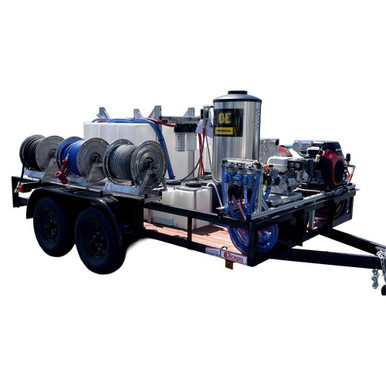
A hot-water pressure washing trailer makes sense when the additional cleaning capability is something you'll use regularly.
1. Commercial Fleet and Heavy-Equipment Cleaning
Fleet vehicles, construction equipment, and commercial machinery can accumulate road grime, lubricants, hydraulic oil, and other petroleum-based residues.
Hot water can help remove suitable oily contamination, particularly when paired with the correct cleaning chemicals.
However, operators must protect sensitive electrical components, seals, coatings, and other equipment that may be damaged by heat or pressure.
2. Grease-Contaminated Concrete
Concrete around commercial kitchens, service areas, loading docks, and maintenance facilities may contain grease or oil.
Hot water can improve the removal of some of these contaminants compared with cold water alone.
For deeply absorbed staining, however, hot water is not a guarantee of complete removal. Detergents, dwell time, agitation, repeat cleaning, or other methods may still be necessary.
Wastewater containing grease, oil, or cleaning chemicals must also be handled according to applicable discharge requirements.
3. Commercial Maintenance and Manufacturing
Commercial facilities may require regular cleaning of machinery, floors, and work areas contaminated with process oils or lubricants.
Where heat is appropriate for the surface and contaminant, a hot-water system can provide a practical cleaning advantage.
Operators should follow site-specific safety procedures and equipment manufacturer requirements.
4. Commercial Cleaning Contractors Serving Multiple Industries
If your business handles a combination of fleet washing, commercial flatwork, maintenance facilities, and other demanding cleaning work, a hot-water trailer can broaden the range of applications your equipment can support.
A hot-water system can generally be operated without heating the water when the configuration allows, giving contractors access to cold-water cleaning as well.
That flexibility is useful—but it comes with additional system complexity.
If grease and oil are paying your invoices, hot water deserves a serious look.
See a ProTool Hot-Water Pressure Washing System in Action
Specs tell you what a pressure washer can do. A proper build shows you how it all comes together.
Take a closer look at a ProTool commercial hot-water pressure washing system, including its equipment layout, heating components, plumbing, and integrated cleaning capabilities.
Built to handle serious cleaning jobs. Not just look impressive on a trailer.
When Is a Cold-Water Pressure Washing Trailer the Better Choice?
Cold-water pressure washing trailers are a practical choice for many commercial and commercial cleaning applications.
You don't need to heat water just because a jobsite is commercial.
General Dirt, Mud, and Dust Removal
Construction equipment, vehicles, pavement, and outdoor work areas often accumulate dirt, mud, and loose debris.
A properly sized cold-water system can handle many of these applications effectively.
Routine Commercial Concrete Cleaning
Sidewalks, walkways, plazas, and other concrete surfaces with ordinary soil buildup can often be cleaned with cold water, appropriate detergents, and a compatible surface cleaner.
The correct pressure and cleaning technique still matter, particularly for decorative or damaged surfaces.
Building Exterior Cleaning
Many building exterior cleaning tasks don't require hot water.
Some surfaces also require low-pressure cleaning methods, making the selection of cleaning chemistry and application equipment more important than maximum pressure or temperature.
Contractors Who Rarely Encounter Grease
If the majority of your business involves ordinary dirt and environmental buildup, the additional expense of a burner, heating coil, and related components may not provide enough value to justify the investment.
Don't pay to heat thousands of gallons of water if your jobs don't need it.
Does Hot Water Clean Faster Than Cold Water?
Hot water can reduce cleaning time for certain grease- and oil-related applications, but it does not guarantee faster cleaning on every surface.
Cleaning performance depends on several factors:
- Contaminant type and severity
- Water temperature
- Water flow and operating pressure
- Detergent selection and concentration
- Chemical dwell time
- Nozzle or surface cleaner configuration
- Surface material and condition
- Operator technique
For example, hot water may help loosen oily residue that resists cold-water cleaning.
But on a concrete surface covered mainly in ordinary dirt, a properly configured cold-water machine with higher flow may be more productive than a smaller hot-water machine.
This is why comparing hot and cold water based only on PSI is misleading.
The cleaning application determines which advantages matter.
How Many GPM Should an Commercial Pressure Washing Trailer Have?
For professional commercial cleaning, water flow is often a major factor in overall productivity.
GPM measures the volume of water delivered by the pressure washer.
Higher flow can improve rinsing and support larger compatible cleaning accessories, provided the water supply and other system components are sized correctly.
| Pressure washer flow | Typical applications |
|---|---|
| 4–5.5 GPM | Smaller professional and light commercial cleaning |
| 8 GPM | Strong all-around commercial cleaning capability |
| 10.5 GPM | Higher-volume commercial and commercial cleaning |
| Dual pressure washers | Multiple operators or specialized high-production work |
Why 8 GPM Is a Strong Commercial Choice
An 8 GPM pressure washer provides substantial water volume for commercial concrete, equipment, and other appropriate cleaning applications.
For a contractor regularly handling commercial jobs, an 8 GPM hot-water system can be a versatile configuration when both high flow and heat are useful.
However, the heating system must be designed to handle the pressure washer's flow rate.
A burner or heating coil that is undersized for the water flow may not achieve the intended temperature rise.
When Does 10.5 GPM Make Sense?
A 10.5 GPM pressure washer can be useful for larger commercial jobs requiring greater rinsing capacity or higher production.
But it also increases water demand.
At continuous rated flow, a 10.5 GPM machine consumes 630 gallons per hour.
That makes incoming water availability, tank capacity, plumbing, and overall system design especially important.
More GPM can mean more production. But only when the rest of the system keeps up.
Does Hot Water Require More PSI?
No. Hot-water cleaning and high-pressure cleaning are separate equipment characteristics.
PSI measures pressure.
GPM measures water flow.
Water temperature describes the heat available to assist the cleaning process.
A hot-water pressure washer does not need a higher PSI rating simply because it heats the water.
In fact, the cleaning advantage of heat can sometimes reduce the amount of mechanical action needed for suitable contaminants.
But operators must still choose appropriate pressure, temperature, nozzles, and cleaning chemicals for the surface.
Excessive heat or pressure can damage coatings, seals, painted surfaces, and other materials.
The right combination is determined by the job.
How Much Water Does an Commercial Pressure Washing Trailer Need?
commercial pressure washing systems can consume substantial amounts of water.
A buffer tank may be used to accommodate differences between the incoming supply and the pressure washer's demand.
The appropriate tank capacity depends on flow rate, supply conditions, available vehicle or trailer capacity, and whether the jobsite provides water.
How Long Will a 200-Gallon Tank Last?
With no incoming water, assuming the entire tank volume is usable:
| Pressure washer flow | Theoretical continuous spraying time |
|---|---|
| 5 GPM | 40 minutes |
| 8 GPM | 25 minutes |
| 10.5 GPM | About 19 minutes |
Actual operating time depends on usable tank capacity, replenishment, and operating conditions.
Water Weight Matters
Water weighs approximately 8.34 pounds per gallon.
| Tank capacity | Water weight |
|---|---|
| 100 gallons | 834 lb |
| 200 gallons | 1,668 lb |
| 300 gallons | 2,502 lb |
| 500 gallons | 4,170 lb |
A hot-water trailer may also carry additional fuel, heating equipment, hose reels, and accessories.
All of that weight must be considered when selecting the trailer, axles, tires, brakes, and tow vehicle.
The trailer's GVWR is the maximum rated loaded trailer weight—not the amount of equipment or water it can carry in addition to its own weight.
A big tank looks great until the math says your trailer can't carry it.
What Makes a Good Hot-Water Pressure Washing Trailer?
A professional hot-water trailer needs more than a pressure washer and a burner.
The complete system must be designed around flow, pressure, heating capacity, water supply, safety, and service access.
Pressure Washer and Engine
The pump and engine should be sized for the required flow and pressure.
Professional commercial systems often use gasoline-powered engines, although other configurations are available.
Burner and Heating Coil
The heating system must be compatible with the intended water flow, pressure, and operating temperature.
The burner, coil, fuel system, and safety controls should be properly integrated.
Temperature Controls and Safety Devices
Depending on the design, hot-water systems may incorporate temperature controls, flow-sensitive burner operation, pressure protection, and other safety devices.
Correct component selection and installation are essential.
Water Tank and Supply Plumbing
The pressure washer needs a reliable supply of water.
Feed plumbing, filtration or strainers, buffer tanks, and connections must be appropriate for the system.
Hose Reels and Hot-Water-Compatible Components
Not every hose, seal, valve, reel swivel, or plumbing component is suitable for hot-water service.
Components must be selected for the system's operating temperature, pressure, and chemical exposure.
A high-pressure hose rated for cold-water use should not automatically be assumed suitable for hot water.
Fuel Storage and Electrical Integration
Hot-water systems may require fuel for both the engine and the burner.
Fuel tanks, lines, wiring, controls, charging equipment, and circuit protection must be integrated appropriately.
Equipment Layout and Maintenance Access
Burners, pumps, filters, valves, and electrical components require service.
A well-designed trailer should provide practical access to equipment without forcing technicians to dismantle half the build for routine maintenance.
Hot water is easy to advertise. Building a complete system that handles it properly is where the engineering matters.
What Are the Downsides of a Hot-Water Pressure Washing Trailer?
Hot water can be a valuable capability, but it adds responsibilities.
Higher Initial Investment
A hot-water system generally costs more because it includes heating equipment, additional controls, fuel components, and related plumbing.
More Maintenance
The burner, heating coil, fuel system, and safety controls require inspection and maintenance in addition to the pressure washer itself.
Additional Fuel Consumption
Heating water requires energy.
Operating costs depend on fuel type, burner efficiency, temperature rise, water flow, and how often heat is used.
More Weight and Space
Heating equipment and additional fuel storage take up room and add weight.
Increased Safety Considerations
Hot water and steam can cause serious burns.
Heating equipment also introduces exhaust, fire, ventilation, and component-temperature considerations.
Commercial operators must follow the equipment manufacturer's procedures and applicable workplace requirements.
Wastewater Management
Hot water does not eliminate wastewater disposal obligations.
Oil, grease, detergents, and other contaminants removed during cleaning may require collection, treatment, or approved disposal.
Never assume contaminated wash water can be discharged into a storm drain.
More capability means more responsibility. That's the tradeoff.
Should You Buy a Hot-Water Trailer or a Truck-Mounted Hot-Water Skid?
Commercial Hot Water Pressure Washing & Soft Washing Truck Skid
$43,845.05
ProTool Commercial Hot Water Pressure Washing & Soft Washing Truck Skid The ProTool Hot Water Pressure Washing & Soft Washing Truck Skid is a fully… read more
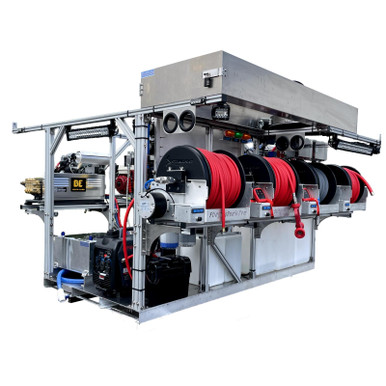
Both platforms can support professional commercial cleaning.
A trailer offers a dedicated equipment platform with space for tanks, heating equipment, reels, and accessories.
A truck-mounted skid integrates the cleaning system directly onto a suitable work vehicle, avoiding the need to tow a separate trailer.
The decision depends on available payload, towing capacity, water requirements, jobsite access, and equipment layout.
For a business operating in commercial facilities with limited maneuvering space, a truck-mounted system may be advantageous.
For contractors who want a dedicated cleaning platform that can be separated from the tow vehicle, a trailer may be preferable.
Neither platform changes the fundamental hot-water-versus-cold-water decision.
Choose the cleaning technology first, then the platform that best supports it.
Can One Trailer Handle Both Hot-Water and Cold-Water Cleaning?
Yes. Many properly designed hot-water pressure washing systems can operate with the burner off, allowing the operator to use unheated water when heat isn't needed.
That gives a hot-water trailer versatility across different applications.
For example, a contractor might use:
- Unheated water for ordinary dirt and debris
- Heated water for suitable greasy equipment
- Heated water with compatible detergent for certain oil-contaminated surfaces
The operating modes and allowable temperatures depend on the equipment's design.
Not every hot-water system has identical controls or operating capabilities, so confirm the manufacturer's specifications.
For contractors who regularly encounter both types of work, this flexibility can be valuable.
Cold water when you want it. Hot water when the job demands it.
Why ProTool for Commercial Pressure Washing Equipment?
At ProTool, we build professional exterior-cleaning equipment for contractors who need complete, integrated systems.
That includes cold-water pressure washing, hot-water pressure washing, soft washing, pure water, and multi-service cleaning configurations.
Our approach goes beyond mounting equipment to a frame.
We consider:
- In-house fabrication and structural layout
- Engine and pump selection
- Heating-system integration
- Water and fuel plumbing
- Electrical controls and circuit protection
- Hose management
- Component accessibility
- Vehicle and trailer requirements
- Complete-system testing before shipment
Commercial cleaning equipment often combines substantial water flow, heat, fuel, electrical systems, and demanding operating conditions.
Those components need to work together.
We also provide long-term technical support to help customers diagnose problems and identify solutions, including years after delivery. Parts and services may be billable.
Qualifying ProTool skids, carts, and systems carry our lifetime warranty, subject to terms and exclusions. Third-party equipment and trailer components may have different warranty coverage.
More capacity. Better integration. Smarter controls. Commercial construction. Real support.
That's the ProTool Way.
Final Recommendation: Hot Water or Cold Water for Commercial Cleaning?
Choose a hot-water pressure washing trailer if your business regularly cleans grease, oil, petroleum residue, or other contaminants that benefit from heated water.
Choose a cold-water pressure washing trailer if most of your work involves dirt, mud, dust, loose debris, and general exterior cleaning where heat provides little advantage.
For higher-production commercial work, evaluate an 8 GPM or larger system, provided the water supply and equipment platform can support it.
And if you need both heated and unheated cleaning, a properly designed hot-water system with selectable heating can provide additional flexibility.
The best system isn't the one with the most features.
It's the one engineered for the work you're actually doing.
Build a Hot-Water or Cold-Water System with ProTool
Whether you're cleaning commercial fleets, commercial equipment, concrete, or large facilities, ProTool can help develop a pressure washing skid or trailer around your requirements.
Tell us your cleaning applications, desired flow rate, water availability, vehicle or trailer platform, and whether you need hot water.
We'll help you explore a configuration that makes sense.
Commercial Hot Water Pressure Washing Trailer
$32,551.30
ProTool 8 GPM Hot Water Pressure Washing & Soft Washing Trailer Hot Water. Heavy Pressure. Zero Mercy for Grime. Some jobs need more than cold… read more
Commercial Hot Water Pressure Washing & Soft Washing Truck Skid
$43,845.05
ProTool Commercial Hot Water Pressure Washing & Soft Washing Truck Skid The ProTool Hot Water Pressure Washing & Soft Washing Truck Skid is a fully… read more
Request Your ProTool Pressure Washing Build
Don't pay for heat you don't need. Don't show up without it when you do.
That's the ProTool Way.
FAQs
Is hot water or cold water better for industrial pressure washing?
Hot water is generally better for industrial cleaning involving grease, oil, and other contaminants that respond to heat. Cold water is often sufficient for dirt, mud, dust, and general surface cleaning. The best choice depends on the contaminant, surface, and frequency of use.
Use heat when it earns its keep. Otherwise, keep it simple.
Does hot water remove grease better than cold water?
Hot water can improve grease and oil removal by reducing the viscosity of certain contaminants and supporting detergent action. Results depend on water temperature, chemistry, surface condition, and cleaning technique, and some stains may require additional treatment.
Grease doesn't like heat. That's exactly why we use it.
Is a hot-water pressure washing trailer worth the extra money?
A hot-water trailer can justify its higher purchase and maintenance costs when a contractor regularly performs grease removal, fleet washing, or other heat-assisted cleaning. For ordinary dirt and routine exterior cleaning, a cold-water system may deliver better value.
Don't buy a burner for bragging rights. Buy it because the jobs pay for it.
Can a hot-water pressure washer also use cold water?
Many hot-water pressure washing systems can operate with the burner switched off, delivering unheated water when heat isn't required. The exact operating modes depend on the equipment's design and manufacturer instructions.
Hot when you need it. Cold when you don't. That's flexibility worth having.
How many GPM should an industrial pressure washing trailer have?
An 8 GPM pressure washer is a strong all-around choice for many professional commercial cleaning applications, while 10.5 GPM or dual-machine systems may suit higher-production or multi-operator work. The water supply, heating system, hoses, and supporting components must all be sized for the intended flow.
Big flow is great. Until the rest of the system can't keep up.
Does hot-water pressure washing require higher PSI?
No. Hot water and high pressure serve different purposes. Water temperature can improve removal of certain oily contaminants, while PSI provides mechanical cleaning force and GPM determines water volume. The correct combination depends on the cleaning application and surface.
Heat, pressure, and flow. Three different tools. Use the right combination.
What are the disadvantages of hot-water pressure washing trailers?
Hot-water trailers generally cost more and require additional maintenance because they include burners, heating coils, fuel systems, and safety controls. They can also be heavier and require additional attention to temperature ratings, ventilation, fuel handling, and operator safety.
More capability. More components. Build it right and maintain it right.
Does ProTool build hot-water pressure washing trailers for industrial cleaning?
Yes. ProTool designs and builds hot-water and cold-water pressure washing skids and trailers for professional commercial and industrial applications. Systems can be configured around required flow, pressure, heating capability, water capacity, hose management, and operating needs, with integrated fabrication, testing, and long-term technical support.
Need serious cleaning power with heat to match? That's our kind of build.