Pressure Washer Nozzle Size Calculator

Table of Contents
- BIG PUMP. WRONG NOZZLE. BAD COMBINATION.
- WHAT DOES A PRESSURE WASHER NOZZLE SIZE CALCULATOR ACTUALLY DO?
- HOW TO USE A PRESSURE WASHER NOZZLE SIZE CALCULATOR
- COMMERCIAL PRESSURE WASHER NOZZLE SIZE CHART
- WHAT DO THE NUMBERS ON A PRESSURE WASHER NOZZLE MEAN?
- PRESSURE WASHER NOZZLE TYPES: WHAT ACTUALLY CHANGES?
- CHOOSING THE RIGHT NOZZLE FOR THE SURFACE
- BUILDING A PROFESSIONAL NOZZLE KIT
- MATCHING NOZZLES TO A PROFESSIONAL PRESSURE WASHING SKID
- THE RIGHT NOZZLE MAKES THE WHOLE MACHINE BETTER
- FAQs
Pressure Washer Nozzle Size Calculator: Find the Right Orifice for Your GPM & PSI
BIG PUMP. WRONG NOZZLE. BAD COMBINATION.
You've got an 8 GPM pressure washer, a fresh set of hoses, and a jobsite waiting.
But what size nozzle should you actually be running?
Size 4? Size 6? Size 8?
Here's the problem: a pressure washer doesn't automatically deliver its advertised PSI just because you pull the trigger.
The nozzle at the end of your gun plays a major role in determining operating pressure. Get the orifice size wrong and you could end up with weak cleaning performance, excessive unloader bypass, or equipment operating outside its intended limits.
That's where a pressure washer nozzle size calculator comes in.
It helps match your machine's flow rate (GPM) with your target operating pressure (PSI) to identify the appropriate nozzle orifice.
And whether you're running a compact 4 GPM unit or a commercial 10.5 GPM monster, the principle is the same.
Match the nozzle to the machine. Not whatever happens to be sitting in your toolbox.
WHAT DOES A PRESSURE WASHER NOZZLE SIZE CALCULATOR ACTUALLY DO?
A pressure washer nozzle size calculator estimates the nozzle orifice required to pass a specific amount of water at a target pressure.
You provide two numbers:
- GPM: How many gallons per minute your pressure washer delivers.
- PSI: The operating pressure you're targeting.
The calculator returns a nominal nozzle size.
It's a simple calculation with a big impact on equipment performance.
Understanding the Relationship Between GPM, PSI, and Nozzle Size
A pressure washer pump moves water.
The nozzle creates resistance to that flow.
On a typical fixed-displacement pressure washer, operating pressure depends on how much water the pump delivers and how much restriction the nozzle creates.
Larger nozzle orifice: Less restriction and generally lower pressure at the same flow.
Smaller nozzle orifice: More restriction and generally higher pressure at the same flow, until the system reaches its limits.
That last part matters.
Installing a smaller nozzle doesn't magically make your pump more powerful. If the nozzle is too restrictive, the unloader may bypass water, and improper system adjustment can create additional heat and operating problems.
A properly selected nozzle helps the machine operate near its intended conditions.
What Happens When You Choose the Wrong Size?
A nozzle that's too large may leave you with lower operating pressure and less cleaning impact.
A nozzle that's too small may cause the system to reach its pressure limit and send excess water through the unloader.
Either situation can hurt productivity.
And on a commercial job, productivity matters.
If your crew is cleaning a large parking structure, warehouse exterior, or thousands of square feet of concrete, small performance problems can turn into serious wasted time.
The wrong nozzle doesn't just affect the spray. It affects the entire job.
What About Cleaning Units (CU)?
You'll sometimes see pressure washer performance described using Cleaning Units:
Cleaning Units = PSI × GPM
For example:
- 4 GPM × 4,000 PSI = 16,000 CU
- 8 GPM × 3,500 PSI = 28,000 CU
- 10.5 GPM × 3,000 PSI = 31,500 CU
Cleaning Units are a rough comparison metric, not a standardized measure of real-world cleaning speed.
Actual productivity also depends on nozzle pattern, surface condition, cleaning chemistry, operator technique, and equipment configuration.
The nozzle doesn't create additional pump capacity. It helps establish how the available flow and pressure are delivered.
A big CU number is nice. A properly matched cleaning system is better.
HOW TO USE A PRESSURE WASHER NOZZLE SIZE CALCULATOR
Let's get to the good stuff.
For conventional pressure washer nozzles, nominal nozzle size is commonly based on the flow passing through the nozzle at 4,000 PSI.
The standard sizing relationship is:
Nozzle Size = GPM × √(4,000 ÷ PSI)
Where:
- GPM = actual water flow through the nozzle.
- PSI = target pressure at the nozzle.
- Nozzle Size = nominal orifice size used in common pressure washing nozzle charts.
This is an approximate sizing method for conventional nozzle systems. Manufacturer-specific designs and operating conditions may require different guidance.
Example 1: A 4 GPM Pressure Washer at 4,000 PSI
Start with:
- Flow: 4 GPM
- Target pressure: 4,000 PSI
Calculation:
4 × √(4,000 ÷ 4,000) = 4.0
Your calculated nozzle size is 4.0.
Pretty straightforward.
Example 2: An 8 GPM Commercial Pressure Washer at 3,500 PSI
Now we're getting into serious commercial cleaning equipment.
Start with:
- Flow: 8 GPM
- Target pressure: 3,500 PSI
Calculation:
8 × √(4,000 ÷ 3,500) ≈ 8.55
Your calculated nozzle size is approximately 8.55.
Depending on the sizes available, you would evaluate the appropriate nearby nozzle size against your equipment's rated pressure and actual performance.
Don't automatically round down to a smaller orifice without checking what that does to system pressure.
Example 3: A 10.5 GPM Pressure Washer at 3,000 PSI
Now we're talking high-flow equipment.
Start with:
- Flow: 10.5 GPM
- Target pressure: 3,000 PSI
Calculation:
10.5 × √(4,000 ÷ 3,000) ≈ 12.12
Your calculated nozzle size is approximately 12.1.
That's substantially larger than the nozzle you'd use on a 4 GPM machine.
And that's the point.
More flow requires more nozzle capacity at the same operating pressure.
COMMERCIAL PRESSURE WASHER NOZZLE SIZE CHART
Here's the reference chart worth saving.
These values are calculated from the standard nozzle sizing relationship and rounded to two decimal places.
| GPM | 2,000 PSI | 2,500 PSI | 3,000 PSI | 3,500 PSI | 4,000 PSI |
|---|---|---|---|---|---|
| 4.0 | 5.66 | 5.06 | 4.62 | 4.28 | 4.00 |
| 5.5 | 7.78 | 6.96 | 6.35 | 5.88 | 5.50 |
| 8.0 | 11.31 | 10.12 | 9.24 | 8.55 | 8.00 |
| 8.5 | 12.02 | 10.75 | 9.81 | 9.09 | 8.50 |
| 10.5 | 14.85 | 13.28 | 12.12 | 11.22 | 10.50 |
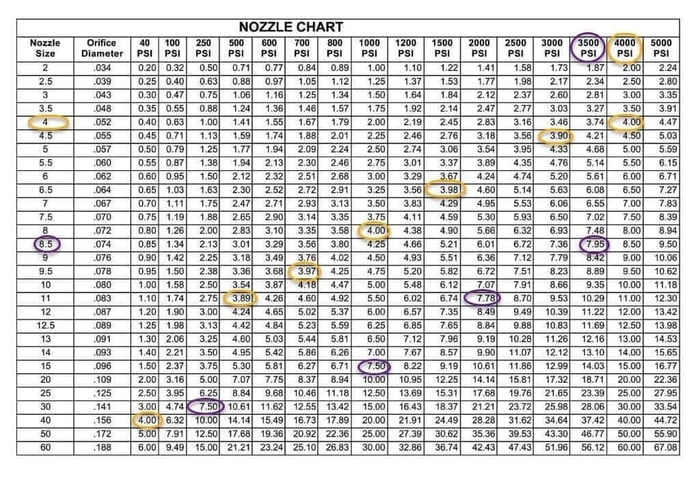
How to use this chart:
- Find your machine's actual GPM on the left.
- Find your desired operating PSI across the top.
- Read the calculated nozzle size at the intersection.
- Compare that result with available manufacturer-approved nozzle sizes.
- Confirm operating pressure with the equipment properly configured.
Important: These are calculated sizes, not automatic purchasing recommendations. Pump output, unloader settings, hose losses, and nozzle manufacturing tolerances can affect actual operating pressure.
How to Read a Nozzle Size Chart PDF
Most printable nozzle charts follow the same general principle.
One axis lists flow rate, and the other lists pressure or nozzle size.
Find your known machine specifications and follow the corresponding row or column to identify the required nozzle size.
Some charts work in reverse: you select a nozzle size and pressure to determine expected flow.
Read the chart headings carefully.
A nozzle chart is only useful if you know which values you're starting with.
WHAT DO THE NUMBERS ON A PRESSURE WASHER NOZZLE MEAN?
A conventional pressure washer tip might be marked:
2504
That typically means:
- 25: A 25° spray angle.
- 04: A nominal size 4.0 orifice.
Another example:
1508
That commonly indicates:
- 15: A 15° spray angle.
- 08: A nominal size 8.0 orifice.
The first part describes the spray pattern.
The second describes the nozzle size.
Some manufacturers use different marking formats, particularly for fractional sizes and specialty nozzles.
Always confirm the actual specification.
Color tells you the spray pattern. Orifice size tells you whether it belongs on your machine.
PRESSURE WASHER NOZZLE TYPES: WHAT ACTUALLY CHANGES?
Nozzle sizing and nozzle spray angle are related, but they're not the same thing.
You can have multiple spray angles with the same nominal orifice size.
Here's a quick guide.
| Nozzle type | Common angle | Typical purpose |
|---|---|---|
| Red | 0° | Specialized concentrated cleaning |
| Yellow | 15° | Aggressive cleaning on suitable hard surfaces |
| Green | 25° | General hard-surface cleaning |
| White | 40° | Wider fan for rinsing and lower-impact work |
| Black | Often 65° | Low-pressure chemical application |
| Turbo | Rotating concentrated jet | Aggressive cleaning of suitable durable surfaces |
Fixed Spray Nozzles: 0°, 15°, 25°, and 40°
A narrower spray angle concentrates the jet into a smaller impact area.
A wider spray angle spreads the water over more surface area.
That changes how aggressively the water strikes the surface.
It doesn't automatically change the machine's PSI when the orifice sizes are equivalent.
A 0° tip can be extremely destructive at commercial operating pressures.
A 40° tip provides wider coverage, but it isn't automatically safe for delicate materials.
Black Soap Nozzles and Chemical Injection
Black soap nozzles are commonly designed to produce low backpressure for compatible downstream chemical injectors.
That lower pressure allows the injector to draw cleaning solution into the water stream.
However, dedicated soft wash systems may use different pumps and nozzles.
Don't assume a standard black tip is appropriate for every chemical application.
Turbo Nozzles: Rotating Cleaning Power
A turbo nozzle rotates a concentrated jet to sweep a circular cleaning pattern.
That makes it useful for certain stubborn deposits on durable surfaces.
But here's the catch: a turbo nozzle also needs to be properly sized for your machine's flow and pressure.
Buying a turbo nozzle based only on its maximum PSI rating is a mistake.
What Does a 4,000 PSI Turbo Nozzle Rating Mean?
A turbo nozzle rated for 4,000 PSI is designed with a maximum rated working pressure of 4,000 PSI.
It doesn't automatically produce that pressure.
You still need to verify the nozzle's supported flow range, orifice size, temperature rating, and connection compatibility.
A turbo nozzle designed for a small pressure washer may be completely unsuitable for an 8 GPM commercial machine.
Turbo Nozzle vs. Other Rotating Attachments
Not every rotating nozzle attachment works the same way.
A turbo nozzle typically rotates a concentrated jet for aggressive cleaning.
An articulating or 360° rotating attachment may instead allow the operator to change spray direction or improve access to awkward areas.
Some specialty rotating heads are designed for tank cleaning, undercarriage rinsing, or equipment washing.
Match the attachment to the job, and check its actual pressure and flow requirements.
CHOOSING THE RIGHT NOZZLE FOR THE SURFACE
A pressure washer nozzle size calculator helps match the nozzle to the machine.
But it doesn't tell you whether that nozzle is appropriate for the surface.
That's a separate decision.
Concrete and Commercial Flatwork
For suitable durable concrete, 15° and 25° nozzles may be appropriate depending on pressure, surface condition, and technique.
For large flat areas, a properly matched surface cleaner is generally the better productivity tool.
And here's something contractors shouldn't overlook:
Surface cleaner nozzle sizing must account for the number of spray tips.
If an 8 GPM machine feeds a two-nozzle surface cleaner with approximately equal flow through each tip, each nozzle handles roughly 4 GPM.
You don't install two nozzles each sized for the full 8 GPM and expect the system to operate normally.
Brick, Stone, and Heavy Deposits
Turbo nozzles can be useful on certain durable masonry surfaces.
But brick, mortar, and stone vary considerably in strength and condition.
A rotating concentrated jet can damage soft masonry, weak mortar, coatings, and deteriorated surfaces.
Test first and use an appropriate pressure.
Vehicles and Equipment
A wider fan with appropriately controlled pressure is generally preferable for vehicle washing.
A 40° tip may be useful in some systems, but the operating pressure, standoff distance, and condition of the vehicle matter more than the nozzle color.
Avoid concentrated jets around paint defects, seals, sensors, cameras, and trim.
Roof Washing and Soft Washing
Roof washing is a different animal.
Asphalt shingles generally require manufacturer-approved low-pressure cleaning methods rather than aggressive high-pressure washing.
Soft wash systems may use specialized chemical application nozzles designed around their pump and fluid requirements.
A conventional high-pressure nozzle sizing chart isn't automatically the right reference for a dedicated low-pressure soft wash pump.
Garden Hose Attachments
A garden hose nozzle or pressure-washer-style adapter isn't equivalent to a machine-powered pressure washer.
A standard garden hose generally operates at much lower pressure.
Attaching a narrow tip doesn't magically turn it into a commercial cleaning system.
If you need professional pressure washing performance, you need the right pump and the right nozzle.
BUILDING A PROFESSIONAL NOZZLE KIT
A quality commercial nozzle kit should be built around your actual equipment.
That means selecting tips with:
- Correct orifice sizes.
- Suitable pressure ratings.
- Appropriate spray angles.
- Compatible quick-connect fittings.
- Durable materials and consistent spray patterns.
- Specialty nozzles matched to your machine's flow and pressure.
A five-color nozzle kit can be useful.
But five tips with the wrong orifice size are still five wrong tips.
When Should You Replace Nozzles?
Nozzle orifices wear over time.
As the opening enlarges, a fixed-flow system may develop less operating pressure.
Watch for:
- Unexplained pressure loss.
- Distorted or uneven spray patterns.
- Visible tip damage.
- Clogging or debris buildup.
Inspect frequently and replace worn or damaged nozzles as needed.
There isn't one universal replacement schedule for every contractor. Water quality, pressure, nozzle material, and operating hours all affect wear.
Nozzle Maintenance: Don't Destroy the Orifice
Shut down the machine and fully relieve pressure before removing a nozzle.
Follow the manufacturer's cleaning instructions.
Use appropriate cleaning tools and avoid drilling, enlarging, or scratching the precision orifice.
Before you blame the pump, inspect the tip. Sometimes the smallest part causes the biggest headache.
MATCHING NOZZLES TO A PROFESSIONAL PRESSURE WASHING SKID
Here's where nozzle sizing becomes part of the bigger picture.
A professional pressure washing skid isn't just an engine and pump bolted to a frame.
It's an integrated system.
And the nozzle at the end of the hose needs to match everything upstream.
Guns, Wands, Hoses, and Surface Cleaners
Your nozzle is only one part of the flow path.
The system also includes:
- Pump and unloader.
- High-pressure plumbing.
- Hose diameter and length.
- Hose reels and swivels.
- Trigger guns and lances.
- Surface cleaners and specialty attachments.
Long hose runs and restrictive fittings can create pressure losses between the pump and the nozzle.
That's why actual pressure at the gun may differ from pressure measured at the pump.
And when multiple spray tips share the flow, such as on a surface cleaner, each nozzle must be sized for its share of the water.
How ProTool Approaches Commercial Pressure Washing Systems
At ProTool, we manufacture professional pressure washing skids, truck builds, and trailers.
Our equipment ranges from straightforward single-operator systems to high-flow commercial rigs and multi-service builds.
We work with 4–5.5 GPM configurations, 8 GPM commercial systems, 10.5 GPM machines, and more complex integrated setups.
Each configuration has different requirements.
An 8 GPM pressure washer doesn't use the same nozzle setup as a 4 GPM machine.
A two-nozzle surface cleaner needs a different sizing approach than a single spray gun.
And a combination pressure washing and soft washing rig has multiple systems with different operating requirements.
The nozzle might be small. The engineering behind a properly matched system isn't.
THE RIGHT NOZZLE MAKES THE WHOLE MACHINE BETTER
A pressure washer nozzle size calculator won't replace proper equipment setup.
But it's one of the easiest ways to avoid a very common mistake.
Start with your machine's actual GPM.
Determine the intended operating PSI.
Calculate the appropriate orifice size.
Then verify the selection against your pump, unloader, hose configuration, accessory ratings, and cleaning application.
It's not complicated.
But it matters.
A serious commercial pressure washer deserves more than a random nozzle and a prayer.
Whether you're replacing worn tips, upgrading a surface cleaner, or planning a complete pressure washing skid, ProTool understands how the entire system needs to work together.
EXPLORE PROTOOL PROFESSIONAL CLEANING EQUIPMENT →
EXPLORE PROTOOL PRESSURE WASHING SKIDS & BUILDS →
More flow. Better integration. Smarter equipment. That's the ProTool way.
FAQs
What size nozzle do I need for my pressure washer?
You need to match the nozzle orifice to your machine's GPM and target PSI.
The standard formula is:
Nozzle Size = GPM × √(4,000 ÷ PSI)
For example, an 8 GPM pressure washer operating at 4,000 PSI generally requires a nominal size 8.0 nozzle.
Use a pressure washer nozzle size calculator or chart to find the appropriate size, then verify it against your equipment specifications.
Don't guess. Your pump deserves better.
What happens if my pressure washer nozzle is too small?
A nozzle that's too small creates excessive restriction.
That can cause the system to reach its pressure limit and send water through the unloader. Improper adjustment or extended bypass operation can lead to heat buildup and equipment problems.
A smaller nozzle isn't a free pressure upgrade.
Match the orifice to your machine's actual flow and intended operating pressure.
What happens if my pressure washer nozzle is too large?
An oversized nozzle generally produces lower operating pressure at the same flow.
Your pressure washer may still move plenty of water, but cleaning impact can suffer.
On commercial jobs, that can mean slower cleaning and more time spent on the same surface.
More nozzle isn't always better. The right nozzle is better.
What nozzle size do I need for an 8 GPM pressure washer?
It depends on your target PSI.
At 4,000 PSI, an 8 GPM machine generally requires a nominal size 8.0 nozzle.
At 3,500 PSI, the calculated size is approximately 8.55.
Actual selection depends on available nozzle sizes, pump specifications, and system configuration.
Same GPM. Different PSI. Different nozzle requirements.
How do I size nozzles for a two-nozzle surface cleaner?
Divide the total water flow by the number of nozzles, assuming the flow is distributed evenly.
For example, an 8 GPM machine feeding a two-nozzle surface cleaner delivers approximately 4 GPM to each nozzle.
Then calculate each nozzle's size using that per-nozzle flow and your target operating pressure.
At 4,000 PSI, that would generally mean two nominal size 4.0 nozzles.
Two spray tips don't each get the full pump output. That's not how plumbing works.
What is the difference between a turbo nozzle and a rotating nozzle?
A turbo nozzle is a type of rotating nozzle that spins a concentrated jet to create an aggressive circular cleaning pattern.
Other rotating attachments may simply redirect the spray or improve coverage in hard-to-reach areas.
Turbo nozzles are useful for certain stubborn deposits on durable surfaces, but they're not suitable for delicate materials.
Same word. Different tools. Know what you're buying.
Can I use a pressure washer nozzle on a garden hose?
Not with the same results you'd get from a pressure washer.
A garden hose operates at much lower pressure than a professional pressure washing system.
Adapters may allow certain nozzles to connect, but they don't create the pump pressure or flow required for commercial cleaning.
A fancy nozzle won't turn your garden hose into an 8 GPM pressure washer.
What nozzle is safest for washing cars?
A wider spray pattern, such as a 40° tip, paired with appropriately controlled pressure is generally preferable to a narrow, aggressive jet.
But nozzle color alone doesn't make a setup safe.
Keep a suitable distance, follow vehicle manufacturer guidance, and avoid concentrated high-pressure water around paint damage, seals, cameras, sensors, and trim.
Clean the car. Don't strip it.
How do I know when to replace my pressure washer nozzle tip?
Watch for pressure loss, uneven spray patterns, visible damage, or an enlarged orifice.
Nozzles wear over time, especially on heavily used commercial equipment.
Inspect them regularly and replace worn or damaged tips.
Before blaming the pump, check the little piece of metal at the end of your gun.
Can ProTool help size nozzles for a commercial pressure washing skid?
Absolutely.
At ProTool, we build complete commercial pressure washing systems, including high-flow truck skids, trailers, and multi-service rigs.
We understand how pump output, pressure, hoses, reels, surface cleaners, and nozzle sizing work together.
Whether you're upgrading an existing setup or designing a complete rig, we can help you match the components to the application.
Because a badass pressure washer deserves a properly engineered system.