Pressure Washer Nozzles Chart: Full Guide

Table of Contents
- Pressure Washer Nozzles Chart: Colors, Sizes, PSI & GPM Explained
- THE WRONG NOZZLE CAN RUIN A PERFECTLY GOOD PRESSURE WASHER SETUP
- UNDERSTANDING PRESSURE WASHER NOZZLES: ANGLE, FLOW, AND PRESSURE
- THE COMPLETE PRESSURE WASHER NOZZLES COLOR CHART
- HOW TO READ A PRESSURE WASHER NOZZLE SIZE CHART
- SPECIALTY PRESSURE WASHER NOZZLES: BEYOND THE STANDARD COLOR SET
- CHOOSING THE RIGHT NOZZLE FOR THE SURFACE
- PRESSURE WASHER NOZZLE KITS: WHAT PROFESSIONALS SHOULD LOOK FOR
- FIVE NOZZLE MISTAKES THAT CAN COST YOU MONEY
- PRESSURE WASHER NOZZLES CHART: THE JOBSITE QUICK REFERENCE
- THE PROTOOL WAY: BUILD THE ENTIRE SYSTEM RIGHT
- GET THE RIGHT NOZZLE. GET THE MOST OUT OF YOUR RIG.
- FAQs
Pressure Washer Nozzles Chart: Colors, Sizes, PSI & GPM Explained
THE WRONG NOZZLE CAN RUIN A PERFECTLY GOOD PRESSURE WASHER SETUP
You've got the pressure washer. You've got the hose. You've got the surface cleaner.
And now you're trying to figure out which tiny piece of metal belongs at the end of your gun.
Seems simple enough, right?
Not exactly.
Choosing the wrong pressure washer nozzle can leave you with disappointing cleaning performance, damaged surfaces, excessive pressure loss, or equipment operating outside its intended specifications.
The right nozzle, on the other hand, helps you get the cleaning performance your machine was built to deliver.
That's why we've put together this pressure washer nozzles chart for professional contractors.
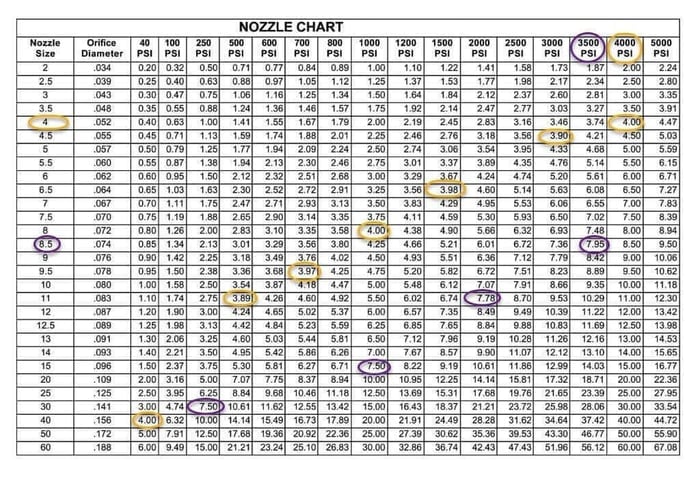
We're covering nozzle colors, spray angles, orifice sizes, GPM, PSI, turbo nozzles, and the mistakes that can turn a routine cleaning job into an expensive afternoon.
Because having a badass pressure washer doesn't mean much if you've got the wrong nozzle on the end of it.
UNDERSTANDING PRESSURE WASHER NOZZLES: ANGLE, FLOW, AND PRESSURE
A pressure washer nozzle does two important things.
First, its orifice restricts water flow to establish the operating pressure for a given pump output.
Second, its spray geometry determines how that water is distributed across the cleaning surface.
Those are different jobs, and understanding the distinction matters.
Spray Angle: Concentrated Force vs. Wider Coverage
A narrow spray angle concentrates the water into a smaller impact area.
A wider spray angle spreads that water over a larger area.
That means a 0° nozzle can deliver a much more aggressive impact than a 40° nozzle, even when both are operating at approximately the same system pressure.
Narrower doesn't automatically mean higher PSI. It means more concentrated impact.
That's why you can damage concrete with a narrow jet even though the machine's pressure hasn't changed.
GPM, PSI, and Orifice Size: The Three-Way Relationship
Here's where nozzle selection gets interesting.
GPM (gallons per minute) is the water volume your pressure washer delivers.
PSI (pounds per square inch) describes the water pressure.
Nozzle orifice size determines how much restriction the nozzle creates at a given flow rate.
For a fixed-flow pressure washer:
- A larger orifice generally produces lower operating pressure.
- A smaller orifice generally requires higher pressure to pass the same flow.
- An excessively small orifice can push the system toward its pressure limits and cause the unloader to bypass water.
- An excessively large orifice may leave you with less cleaning pressure than you expected.
Your pump, unloader, hose, fittings, and nozzle all need to work together.
Big pump. Wrong nozzle. Congratulations, you've built an expensive disappointment.
THE COMPLETE PRESSURE WASHER NOZZLES COLOR CHART
Most conventional pressure washer tip sets use five familiar colors.
These colors identify spray patterns and common applications. They do not identify a universal PSI rating.
A green 25° nozzle can be available in many different orifice sizes. So can a yellow 15° nozzle.
Here's the pressure washer nozzles chart you'll want to keep handy.
| Nozzle color | Spray angle | Relative surface impact | Typical use |
|---|---|---|---|
| Red | 0° | Extremely concentrated | Specialized spot cleaning on suitable hard surfaces |
| Yellow | 15° | Aggressive | Heavy deposits on durable surfaces |
| Green | 25° | Moderate to aggressive | General hard-surface cleaning |
| White | 40° | More distributed | Rinsing and less aggressive cleaning |
| Black | Commonly 65° | Low-pressure application | Downstream chemical application |
Actual cleaning impact depends on operating pressure, nozzle size, flow, distance, and surface condition. The black soap tip is designed to create low backpressure for compatible chemical injection systems.
Red Nozzle — 0°: Pinpoint Power
The red nozzle produces a narrow, concentrated stream.
And when we say concentrated, we mean it.
This is not the nozzle you casually wave across a driveway, painted surface, or piece of wood.
A 0° jet can gouge materials, remove coatings, and cause serious injury.
There are specialized applications for pinpoint jets on suitable durable surfaces, but for most professional exterior cleaning jobs, a broader pattern is the smarter choice.
Maximum concentration. Minimum forgiveness.
ProTool ProTip: Red = Dead. Never use a Red tip for pressure washing. It's way too easier to damage any surface - let alone sensitive surfaces.
Yellow Nozzle — 15°: Aggressive Cleaning
The yellow nozzle spreads the jet into a narrow fan.
It's commonly used for stubborn deposits on durable surfaces where aggressive cleaning is appropriate.
Think heavy grime on suitable concrete or certain metal surfaces.
But don't confuse aggressive cleaning with good cleaning.
Get too close, use excessive pressure, or work on the wrong surface and you can still cause permanent damage.
Green Nozzle — 25°: The Everyday Workhorse
The green 25° nozzle is one of the most versatile tips in a conventional pressure washer kit.
It offers a useful balance between cleaning impact and spray coverage.
On suitable hard surfaces, it can work well for general washing, equipment cleaning, and targeted jobs where you don't need the aggression of a 15° tip.
For contractors, it's a practical starting point when the surface can tolerate the selected operating pressure.
Not too narrow. Not too wide. Just a solid all-around tool.
White Nozzle — 40°: Wider Coverage, Less Aggressive Impact
The white nozzle spreads water over a wider fan.
That makes it useful for rinsing and lower-impact applications when paired with appropriate pressure, distance, and technique.
It's often considered for vehicles, painted surfaces, and other applications where a narrow jet would be inappropriate.
But here's an important distinction.
A 40° tip on a high-pressure commercial machine is not automatically safe for siding, glass, automotive paint, or wood.
The machine's actual pressure, standoff distance, and surface condition still matter.
Black Nozzle — Typically 65°: Chemical Application
The black nozzle is commonly associated with low-pressure downstream chemical application.
Its purpose is different from the standard high-pressure cleaning tips.
A properly matched low-pressure soap tip allows a compatible downstream injector to draw cleaning solution into the water stream.
That's useful for certain house-washing and chemical application workflows.
However, not every soft wash system uses a conventional black nozzle. Dedicated soft wash pumps and chemical delivery systems often use different nozzles and application methods.
Match the tip to the system. Don't assume every chemical setup works the same way.
HOW TO READ A PRESSURE WASHER NOZZLE SIZE CHART
Here's where professional nozzle selection really begins.
Knowing the color is useful.
Knowing the orifice size is essential.
A pressure washer nozzles chart that only shows colors tells you how the spray is shaped. It doesn't tell you whether the nozzle is properly sized for your pump.
Understanding Nozzle Numbers
Many conventional spray tips use markings such as:
2504
That typically means:
- 25: 25° spray angle.
- 04: Nominal size 4.0 orifice.
A tip marked 1505 would typically indicate a 15° spray pattern and a size 5.0 orifice.
Some manufacturers use additional digits or different marking conventions, particularly for fractional sizes.
Always check the manufacturer's identification system rather than assuming every code follows the same format.
Pressure Washer Nozzle Size Chart by GPM and PSI
For conventional pressure washer nozzles, the nominal orifice size is commonly based on the flow that would pass through the nozzle at 4,000 PSI.
A useful sizing relationship is:
Nozzle size ≈ GPM × √(4,000 ÷ PSI)
Here's a practical reference chart for several commercial pressure washer configurations.
| Machine flow | Target pressure | Calculated nozzle size | Practical selection |
|---|---|---|---|
| 4.0 GPM | 4,000 PSI | 4.00 | Size 4.0 |
| 5.5 GPM | 3,500 PSI | 5.88 | Check available sizes near 6.0 |
| 8.0 GPM | 3,500 PSI | 8.55 | Check available sizes near 8.5–9.0 |
| 8.0 GPM | 4,000 PSI | 8.00 | Size 8.0 |
| 10.5 GPM | 3,000 PSI | 12.12 | Check available sizes near 12.0 |
These are calculated examples, not universal equipment prescriptions. Confirm actual pump output, manufacturer specifications, unloader operation, and available nozzle increments before selecting a tip. A nozzle smaller than the calculated size may exceed the intended pressure.
Notice something?
An 8 GPM machine doesn't use the same nozzle as a 4 GPM machine just because they're both running at 4,000 PSI.
The higher-flow machine needs a larger orifice.
That's why choosing a nozzle by color alone is a mistake.
How to Use a Nozzle Size Calculator
If you're using an online pressure washer nozzle size calculator, you'll generally need two numbers:
- Your machine's actual GPM.
- Your desired operating PSI.
Enter those values and the calculator will estimate the required orifice size.
For example, an 8 GPM machine targeting 4,000 PSI calculates to a size 8.0 nozzle.
For an 8 GPM machine targeting 3,500 PSI, the calculated size is approximately 8.55.
The next step is choosing an available nozzle size that works with your equipment and pressure requirements.
Don't blindly round down to a smaller nozzle. That may require more pressure than your system should produce.
And don't assume the pressure printed on the machine is exactly what you're getting at the gun.
Measure actual performance. Don't build your setup around wishful thinking.
What Happens When the Nozzle Size Is Wrong?
Too large: You may lose operating pressure and cleaning impact.
Too small: The system may reach the unloader setting, bypass water, and generate unnecessary heat or operating problems if improperly configured.
The solution isn't to keep installing smaller nozzles until the pressure gauge looks impressive.
It's to size the nozzle correctly and make sure the entire pressure washing system is properly adjusted.
SPECIALTY PRESSURE WASHER NOZZLES: BEYOND THE STANDARD COLOR SET
Standard fan tips are useful.
But professional contractors have other options, and some of them can make a big difference in the right application.
Turbo Nozzles: Rotating Pinpoint Cleaning Power
A turbo nozzle, also called a rotary nozzle, uses a rotating concentrated jet to sweep a circular cleaning pattern.
It combines the aggressive impact of a narrow stream with movement across a larger area.
On suitable durable surfaces, this can help remove stubborn deposits more efficiently than a stationary pinpoint jet.
But turbo nozzles are aggressive.
They're not the tool for delicate siding, automotive paint, soft wood, or questionable coatings.
A turbo nozzle can be a beast on the right surface. On the wrong surface, it's a very expensive mistake.
Can You Use a 4,000 PSI Turbo Nozzle?
A turbo nozzle advertised as rated for 4,000 PSI has a maximum rated working pressure of 4,000 PSI.
That does not mean it automatically produces 4,000 PSI or that it is appropriate for every pressure washer.
You still need to verify:
- Maximum pressure rating.
- Supported flow range.
- Correct orifice size.
- Temperature limits.
- Connection compatibility.
A turbo nozzle must be matched to the machine's actual operating conditions.
A pressure rating is a limit, not a performance upgrade.
360° Rotating Nozzle Attachments
Some specialty nozzles use rotating or adjustable heads to direct the spray into hard-to-reach areas.
These aren't necessarily the same as turbo nozzles.
A turbo nozzle typically rotates a concentrated jet to create an aggressive cleaning pattern.
A rotating or articulating attachment may instead change the direction of the spray for rinsing tanks, equipment, undercarriages, or awkward spaces.
Different tools. Different jobs.
Turbo Nozzle vs. Surface Cleaner
For professional contractors, this is an important comparison.
A turbo nozzle can be useful for localized deposits and detailed work on suitable surfaces.
A properly sized surface cleaner is generally a better choice for cleaning large, flat areas such as concrete sidewalks, driveways, and commercial pavement.
Surface cleaners use rotating spray bars within a housing to provide consistent coverage and help control overspray.
Cleaning an entire parking lot with a handheld turbo nozzle? You might want to rethink that plan.
CHOOSING THE RIGHT NOZZLE FOR THE SURFACE
Here's a second pressure washer nozzles chart focused on actual cleaning applications.
| Surface or job | Common starting approach | Important caution |
|---|---|---|
| Durable concrete | 15°–25° fan or compatible surface cleaner | Test first; excessive impact can etch concrete |
| Heavy localized deposits | Turbo nozzle on suitable hard surfaces | Highly aggressive; avoid delicate materials |
| Vehicles | Wider fan with appropriately reduced pressure | Protect paint, seals, sensors, and trim |
| House siding | Low-pressure application and rinsing | High pressure can force water behind siding |
| Wood decks | Low-pressure, wider spray where appropriate | Wood fibers can be damaged easily |
| Asphalt shingles | Manufacturer-approved low-pressure roof cleaning | Never use aggressive high-pressure cleaning |
| Chemical application | Compatible low-pressure downstream or soft wash tip | Confirm injector and chemical compatibility |
| Commercial flatwork | Properly sized surface cleaner | Match nozzles to machine flow and pressure |
These are starting points, not guaranteed safe settings. Always follow the surface manufacturer's instructions and test an inconspicuous area.
Best Nozzle for Concrete and Driveways
Concrete is tough.
But it's not indestructible.
A 15° or 25° fan nozzle can be appropriate for certain concrete cleaning tasks, depending on pressure, surface condition, and operator technique.
For larger areas, a properly matched surface cleaner is usually the more productive choice.
And remember: new, weak, decorative, or deteriorated concrete may be especially vulnerable to damage.
Best Nozzle for Washing Cars
A wide spray pattern with appropriately controlled pressure is generally preferable to an aggressive narrow jet.
A 40° nozzle may be suitable in some setups, but the machine's pressure and the distance from the vehicle matter far more than the color alone.
Avoid directing concentrated high-pressure water at damaged paint, seals, cameras, sensors, or vulnerable trim.
For chemical application, use a properly matched foam cannon or other suitable low-pressure accessory.
Best Nozzle for Roof Washing and Soft Washing
Here's one we want to make very clear.
An asphalt shingle roof is not a pressure washing surface.
Roof cleaning should follow the roofing manufacturer's approved methods, typically involving appropriate low-pressure chemical application rather than aggressive high-pressure jets.
A black downstream soap tip may be useful in certain compatible systems, but dedicated soft wash equipment often uses different application nozzles.
The correct choice depends on your pump, chemistry, required reach, and application method.
Best Nozzle for House Washing and Siding
House washing isn't about seeing how much pressure the siding can survive.
It's about removing contaminants without damaging the building.
Low-pressure chemical application and controlled rinsing are often preferable to high-pressure cleaning.
A wider fan can help distribute water, but a 40° nozzle connected to a high-pressure machine can still cause damage.
Clean the house. Don't pressure-test its waterproofing.
Best Nozzle for Wood Decks
Wood deserves special care.
Aggressive jets can raise fibers, gouge boards, and leave permanent wand marks.
Use the lowest effective pressure, appropriate chemistry, a suitable wide spray pattern, and careful technique.
When in doubt, test first.
PRESSURE WASHER NOZZLE KITS: WHAT PROFESSIONALS SHOULD LOOK FOR
A professional nozzle kit should be selected around the machine, not just the number of colorful tips in the package.
Look for:
- Correct orifice sizes for your GPM and PSI.
- Suitable maximum pressure ratings.
- Compatible quick-connect fittings.
- Durable nozzle materials and consistent spray patterns.
- The angles and specialty tips your work actually requires.
- Replacement tips that are easy to identify and reorder.
A basic five-color kit can be useful.
But a contractor running an 8 GPM machine needs different orifice sizing than someone running a 4 GPM machine.
Five colors don't help much if all five tips are the wrong size.
When Should You Replace Pressure Washer Nozzles?
Nozzles wear over time.
As the orifice enlarges, a fixed-flow system may produce less operating pressure.
You may also notice an uneven spray pattern, poor cleaning performance, or physical damage.
Check for:
- Unexplained pressure loss.
- Distorted or inconsistent fan patterns.
- Visible wear or damaged nozzle edges.
- Clogging or debris buildup.
Inspect frequently and replace worn or damaged tips as needed.
There's no universal replacement interval that applies to every contractor. Water quality, operating hours, pressure, and nozzle material all affect service life.
How to Clean a Clogged Nozzle
First, shut down the equipment and fully relieve pressure.
Remove the nozzle according to the manufacturer's instructions.
Use the recommended cleaning method, such as gentle flushing or an appropriate nozzle-cleaning tool.
Avoid damaging or enlarging the precision orifice with an oversized wire, drill bit, or other improvised tool.
Inspect the nozzle before reinstalling it.
A $10 maintenance shortcut isn't worth wrecking your spray pattern.
FIVE NOZZLE MISTAKES THAT CAN COST YOU MONEY
1. Choosing by Color Instead of Orifice Size
Color tells you the spray angle.
It doesn't tell you whether the nozzle matches your pump.
2. Using Aggressive Tips on Delicate Surfaces
A narrow jet can damage wood, paint, siding, concrete, and other materials.
3. Installing an Undersized Nozzle to Chase More PSI
Your pressure washer has operating limits.
A smaller nozzle isn't a substitute for properly matched equipment.
4. Ignoring Nozzle Wear
Worn nozzles can reduce pressure and compromise spray consistency.
Inspect them before assuming your pump is failing.
5. Forgetting About Flow When Upgrading Equipment
Switching from a 4 GPM pressure washer to an 8 GPM machine?
Your nozzle requirements change.
The same goes for turbo nozzles, surface cleaners, and other flow-dependent accessories.
More GPM deserves more thought than just bolting on a bigger pump.
PRESSURE WASHER NOZZLES CHART: THE JOBSITE QUICK REFERENCE
Save this chart for the shop, truck, or trailer.
| What you need to know | Quick answer |
|---|---|
| Red tip | 0° concentrated jet; specialized use. Or Don't. |
| Yellow tip | 15° aggressive fan |
| Green tip | 25° general-purpose fan |
| White tip | 40° wider fan for less aggressive applications |
| Black tip | Commonly 65° low-pressure chemical application |
| Orifice size | Match to actual GPM and target PSI |
| 4 GPM at 4,000 PSI | Nominal size 4.0 |
| 8 GPM at 4,000 PSI | Nominal size 8.0 |
| 8 GPM at 3,500 PSI | Calculated size approximately 8.55 |
| Turbo nozzle | Aggressive rotating jet for suitable hard surfaces |
| Surface cleaner | Usually better for large, flat cleaning areas |
| Soft washing | Use compatible low-pressure application equipment |
The golden rule: Match the nozzle to the machine AND the surface.
One without the other is asking for trouble.
THE PROTOOL WAY: BUILD THE ENTIRE SYSTEM RIGHT
At ProTool, we spend a lot of time thinking about pressure, flow, plumbing, and how professional cleaning equipment actually performs in the field.
That's because we don't just sell accessories.
We build complete pressure washing skids, soft wash systems, truck rigs, and trailers designed around the demands of commercial contractors.
And when you're designing an integrated cleaning system, nozzle selection matters.
An 8 GPM pressure washer needs properly matched accessories.
A dual-operator setup needs equipment configured for the intended operating conditions.
A high-flow commercial rig needs plumbing, hoses, fittings, surface cleaners, and nozzles that work together.
You don't build a serious rig by guessing at the little stuff.
Whether you're replacing worn tips, choosing accessories for a new machine, or planning a complete commercial cleaning build, getting the details right makes the entire system better.
That's how we approach equipment at ProTool.
GET THE RIGHT NOZZLE. GET THE MOST OUT OF YOUR RIG.
A pressure washer nozzle might be one of the smallest components on your equipment.
But it's also one of the most important.
The right nozzle delivers the spray pattern, operating pressure, and flow characteristics your job requires.
The wrong one can waste time, compromise cleaning performance, or damage something expensive.
Use this pressure washer nozzles chart as a starting point, verify your machine's specifications, and choose accessories designed for the work you're actually doing.
And if you're putting together a serious commercial cleaning rig?
Build it right from the pump to the nozzle.
EXPLORE PROTOOL PROFESSIONAL CLEANING EQUIPMENT →
EXPLORE PROTOOL SKIDS & CUSTOM BUILDS →
More cleaning. Less guesswork. That's the ProTool way.
FAQs
What do the different pressure washer nozzle colors mean?
The standard colors identify spray angles:
- Red: 0° concentrated jet.
- Yellow: 15° aggressive fan.
- Green: 25° general-purpose fan.
- White: 40° wider fan.
- Black: Commonly 65° low-pressure soap application.
Here's the important part: Color tells you the spray angle, not the nozzle's PSI rating.
A nozzle still needs the correct orifice size for your machine.
How do I know what size pressure washer nozzle I need?
Start with your pressure washer's actual GPM and target operating PSI.
A conventional nozzle size can be estimated using:
Nozzle size = GPM × √(4,000 ÷ PSI)
For example, an 8 GPM machine operating at 4,000 PSI generally calls for a nominal size 8.0 nozzle.
Always confirm the size against your equipment specifications.
Don't just grab whatever colorful tip happens to be lying around.
Does a smaller pressure washer nozzle increase PSI?
A smaller orifice creates more restriction, which can increase operating pressure on a fixed-flow system.
But there's a limit.
If the nozzle is too small, your unloader may start bypassing water, and the system can operate outside its intended conditions if improperly adjusted.
A smaller hole isn't a magical horsepower upgrade.
Match the nozzle to your pump instead of chasing pressure numbers.
What's the best pressure washer nozzle for concrete?
For suitable durable concrete, 15° and 25° nozzles are common options, depending on the pressure and cleaning requirements.
For larger areas, a properly sized surface cleaner is usually the better tool.
Turbo nozzles can help with stubborn localized deposits, but they're aggressive and can damage concrete.
Just because concrete is hard doesn't mean you can't carve your initials into it with the wrong nozzle.
What's the difference between a turbo nozzle and a regular pressure washer nozzle?
A regular fan nozzle produces a fixed spray pattern.
A turbo nozzle rotates a concentrated jet to create a circular cleaning pattern, delivering aggressive impact over a wider area.
Turbo nozzles can be useful for stubborn deposits on suitable hard surfaces.
But they're not appropriate for every job.
Great tool for the right surface. Terrible choice for delicate siding or automotive paint.
Can I use a 4,000 PSI turbo nozzle on any pressure washer?
No.
A 4,000 PSI rating is the nozzle's maximum rated working pressure, not a guarantee of compatibility.
You also need to match the nozzle's orifice size, supported flow range, temperature rating, and connections to your machine.
Just because it says 4,000 PSI doesn't mean it's right for your rig.
Which pressure washer nozzle should I use for house washing?
For many house-washing applications, low-pressure chemical application and controlled rinsing are preferable to aggressive high-pressure cleaning.
A compatible downstream injector may use a black low-pressure soap nozzle. Dedicated soft wash systems may use different tips.
The correct choice depends on the siding, cleaning chemistry, equipment, and surface manufacturer's instructions.
The goal is to clean the house, not blast water behind the siding.
How do I know when a pressure washer nozzle needs replacing?
Watch for reduced operating pressure, uneven spray patterns, visible damage, or an enlarged orifice.
Nozzles wear with use, and a worn tip can affect cleaning performance.
Inspect them regularly, especially on heavily used commercial equipment.
Before blaming an expensive pump, check the little piece of metal at the end of your gun.
Can I use the same pressure washer nozzle on a 4 GPM and an 8 GPM machine?
Not if you expect both machines to operate at their intended pressure.
An 8 GPM pressure washer generally needs a larger nozzle orifice than a 4 GPM machine operating at the same PSI.
For example, at 4,000 PSI, a 4 GPM machine typically uses a size 4.0 nozzle, while an 8 GPM machine typically uses a size 8.0.
Double the flow doesn't mean you can keep using the same tip.
Can ProTool help me select nozzles and accessories for a commercial pressure washing skid?
Absolutely.
At ProTool, we build complete professional pressure washing systems, not just individual components.
We understand how pumps, GPM, PSI, hoses, plumbing, surface cleaners, and nozzles work together.
Whether you're upgrading accessories or planning a complete skid, truck, or trailer build, we can help you match the equipment to the job.
Because a serious pressure washer deserves more than a random nozzle and a prayer.