Best Pressure Washing Trailer for a Half-Ton Truck: What ProTool Recommends
Table of Contents
- Can a Half-Ton Truck Tow a Commercial Pressure Washing Trailer?
- ProTool's First Pick: A Dual-Axle Commercial Pressure Washing Trailer
- The Biggest Weight Variable: Water
- What Matters More Than the Words “Half-Ton”?
- Do You Really Need a Smaller Pressure Washing Trailer?
- Our Compact Alternative: ProTool Utility Pressure Washing Trailer
- Should You Choose Hot Water or Cold Water?
- Why Buy From the Company Building the Trailer?
- Our Final Recommendation for Half-Ton Truck Owners
- FAQs
Driving an F-150, Silverado 1500, Ram 1500, GMC Sierra 1500, or Toyota Tundra? You may have more pressure washing trailer options than you think.
At ProTool, we don't automatically recommend the smallest pressure washing trailer just because a contractor drives a half-ton pickup. Our recommendation is to start with the work you want to perform, determine what your specific truck can safely tow, and then choose the most capable trailer that fits those limits.
For many professional cleaning businesses, that means seriously considering a dual-axle commercial pressure washing trailer rather than immediately settling for a lightweight starter setup.
Our first recommendation to evaluate is the ProTool Commercial Hot Water Pressure Washing Trailer. It offers a commercial hot-water equipment platform worth considering for contractors who want more capability and room to grow. Whether it's suitable for your particular half-ton pickup depends on the trailer's actual loaded weight, tongue weight, and your truck's individual ratings.
If your truck or operating requirements call for something smaller, our ProTool Utility Pressure Washing Trailer is a compact alternative.
The goal isn't to buy the biggest trailer you can find. It's to avoid buying less equipment than your business needs simply because of a misconception about half-ton trucks.
See all trailers ->
Can a Half-Ton Truck Tow a Commercial Pressure Washing Trailer?
Yes. A properly equipped half-ton pickup can tow many commercial pressure washing trailers, including some dual-axle configurations, provided the fully loaded trailer and tongue weight remain within the truck's specific ratings.
The important words are properly equipped and fully loaded.
A half-ton designation doesn't tell you everything about towing capability. Two trucks with the same model badge can have substantially different ratings depending on their model year, engine, drivetrain, cab configuration, axle ratio, and towing equipment.
That's why we don't make blanket claims that every F-150, Silverado 1500, or Ram 1500 can pull a particular trailer.
At ProTool, we look at the complete towing combination—not just the truck badge or the trailer's empty weight.
Towing a Trailer Is Not the Same as Carrying a Skid
This distinction matters.
When you install a pressure washing skid directly into a truck bed, the weight of the skid, water, chemicals, equipment, and accessories must fit within the truck's available payload and axle ratings.
When you tow a trailer, the trailer carries most of that weight on its own axles. The truck still needs sufficient towing capacity, hitch capacity, and available payload to accommodate the trailer's tongue weight, passengers, cargo, and other loads.
Our recommendation for truck-mounted skids is different from our recommendation for towable trailers.
For commercial truck-bed skid installations, we generally recommend starting with an F-250-class truck, moving to an F-350-class truck for larger systems, and considering a dual-rear-wheel flatbed for substantial water capacity or multiple cleaning systems. The actual configuration must still be checked against the vehicle's ratings.
But for a trailer? A properly equipped half-ton pickup may be an excellent tow vehicle.
ProTool's First Pick: A Dual-Axle Commercial Pressure Washing Trailer
If a contractor comes to us with a half-ton pickup and wants a serious pressure washing business setup, we're not automatically pointing them toward the smallest trailer in the catalog.
We'd first evaluate whether our Commercial Hot Water Pressure Washing Trailer fits their truck and their work.
Why?
Because buying a trailer is about more than moving a pressure washer from one driveway to the next. It's about choosing a platform that can support the kind of cleaning operation you want to run.
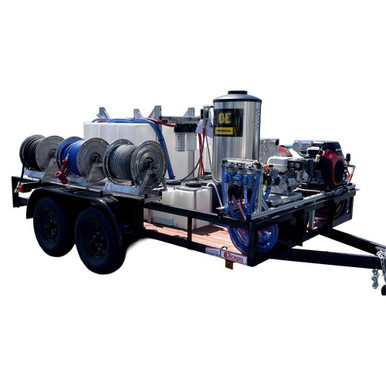
Commercial Hot Water Pressure Washing Trailer
$32,551.30
ProTool 8 GPM Hot Water Pressure Washing & Soft Washing Trailer Hot Water. Heavy Pressure. Zero Mercy for Grime. Some jobs need more than cold… read more
Why We Like the Commercial Hot-Water Platform
Hot-water capability opens up more applications. Cold water is effective for many residential cleaning jobs, but heated water can make a substantial difference when tackling grease, oils, and certain industrial soils, particularly when paired with appropriate detergents and cleaning methods.
A dedicated commercial trailer keeps equipment organized. Tanks, hoses, reels, pumps, fuel systems, and accessories need to work together as one practical cleaning system.
A dual-axle platform can make sense for larger equipment packages. Properly designed tandem-axle trailers can provide additional load-carrying capacity and distribute trailer loads across two axles. Actual capacity and towing suitability depend on the trailer's rated components, weight distribution, and loaded configuration.
It gives a growing contractor a more capable starting point. If you already know you want to pursue commercial concrete, fleet, equipment, or industrial cleaning, it may be worth investing in the right platform from the beginning instead of immediately planning your next upgrade.
That doesn't mean hot water is necessary for every driveway or house wash. It means we believe contractors should evaluate the equipment they'll need for tomorrow's work—not just today's jobs.
Before We Recommend It for Your Truck
We need to verify the trailer's configuration and actual loaded weight against your vehicle.
We would not recommend this trailer based solely on the fact that your truck is a half-ton pickup.
A trailer that fits one F-150 may not fit another. That's why we check the numbers.
[Product placement: ProTool Commercial Hot Water Pressure Washing Trailer]
The Biggest Weight Variable: Water
Pressure washing trailers are unusual because their operating weight can change dramatically depending on how much water they carry.
Water weighs approximately 8.34 pounds per gallon.
| Water carried | Approximate water weight |
|---|---|
| 50 gallons | 417 lb |
| 100 gallons | 834 lb |
| 200 gallons | 1,668 lb |
| 300 gallons | 2,502 lb |
| 500 gallons | 4,170 lb |
These figures represent water alone.
They don't include the trailer structure, pressure washer, engine, burner, fuel, tanks, hose reels, hoses, tools, chemicals, or other equipment.
A trailer that feels light and easy to tow with empty tanks may behave very differently when fully loaded.
Don't Confuse Trailer GVWR With Payload
GVWR—Gross Vehicle Weight Rating—is the maximum allowable loaded weight of the trailer, not the amount of equipment or water you can add to it.
For example, a trailer rated for 7,000 pounds GVWR does not have 7,000 pounds of available payload. The trailer itself and everything permanently installed on it consume part of that rating.
Available cargo capacity is generally determined by subtracting the trailer's actual empty or as-equipped weight from its GVWR, subject to axle, tire, and other component limits.
And remember: even if the trailer is within its own GVWR, it still must be within the towing vehicle's applicable limits.
What Matters More Than the Words “Half-Ton”?
At ProTool, these are the numbers we'd want to review before recommending a trailer.
| Rating or measurement | Why it matters |
|---|---|
| Maximum trailer towing rating | The truck's rated towing limit for its specific configuration |
| Available truck payload | Must accommodate occupants, cargo, hitch equipment, and trailer tongue weight |
| Tongue weight | The downward load the trailer places on the hitch and tow vehicle |
| Hitch and receiver ratings | The hitch assembly must be rated for the actual trailer and tongue loads |
| Truck axle and tire ratings | Must not be exceeded when the trailer is connected and the truck is loaded |
| Trailer GVWR and axle ratings | Establish the trailer's maximum rated loaded weight and component limits |
| Actual loaded trailer weight | Includes water, fuel, equipment, tools, chemicals, and accessories |
| GCWR | The maximum rated combined weight of the loaded truck and trailer |
The vehicle's owner's manual, manufacturer towing guide, certification labels, and actual weighing are more useful than a generic online statement about what a half-ton truck can tow.
A properly selected weight-distribution hitch may be appropriate for some combinations when the vehicle, hitch, and trailer manufacturers permit it. It does not increase the truck's rated towing or payload capacity.
Trailer brakes, brake-controller compatibility, tire condition, load securement, and applicable legal requirements also need to be addressed.
The right towing setup is a complete system. Just like the cleaning equipment riding behind it.
Do You Really Need a Smaller Pressure Washing Trailer?
Not necessarily.
At ProTool, we recommend choosing trailer size around three things:
1. Your actual cleaning applications. Residential driveways, house washing, commercial concrete, fleet washing, and industrial degreasing can require very different equipment configurations.
2. Your water and equipment requirements. A higher-flow pressure washer, larger buffer tank, hot-water burner, additional cleaning systems, and extra hose reels all influence the final build.
3. Your truck's real-world towing limits. We need the actual vehicle configuration and loaded trailer weights—not assumptions based on the pickup's model name.
If those factors support a larger commercial trailer, we'd rather see you invest in the system that makes sense for your business.
If they don't, a smaller trailer is the right answer.
There's nothing wrong with compact equipment. There is something wrong with undersizing a system because nobody checked what the truck could actually handle.
Our Compact Alternative: ProTool Utility Pressure Washing Trailer
For contractors who prioritize maneuverability, a lighter equipment package, lower initial investment, or straightforward residential work, our ProTool Utility Pressure Washing Trailer deserves a look.
Its established configuration includes:
- 5 GPM at 3,000 PSI
- 100-gallon water tank
- Electric-start pressure washer
- Two stainless steel electric hose reels
- 300 feet of 3/8-inch high-pressure hose
- 150 feet of 3/4-inch inlet hose
- Recessed utility lockbox with 110V battery charging
- Trailer brakes
- 3,000-pound trailer GVWR
Important: That 3,000-pound GVWR is the trailer's maximum rated loaded weight, not its payload capacity.
The 100-gallon tank alone carries approximately 834 pounds of water when full. The actual completed trailer weight, available cargo capacity, tongue weight, and truck ratings still need to be verified.
Is 5 GPM Enough for Professional Work?
Absolutely—for the right applications.
At ProTool, we consider 8 GPM our gold standard for professional pressure washing when the budget, water supply, and equipment platform support it.
Higher flow generally improves rinsing productivity and supports larger surface-cleaning equipment when properly matched.
But a 5 GPM machine is a capable professional option for residential driveways, house washing, and lighter commercial cleaning. It can also be a smart fit when a compact trailer and lower water demand are priorities.
A 100-gallon tank supplies approximately 20 minutes of theoretical operation at 5 GPM without replenishment. Actual runtime depends on incoming water, usage patterns, and usable tank volume.
Our rule of thumb: Go with 8 GPM when you can properly support it. Choose 5 GPM when a compact, efficient residential setup better fits your operation.
[Product placement: ProTool Utility Pressure Washing Trailer]
Should You Choose Hot Water or Cold Water?
This is another area where we encourage buyers to think beyond their first few jobs.
| Your primary work | ProTool's recommendation |
|---|---|
| Residential driveways and routine exterior cleaning | Cold water is often sufficient |
| House washing and general residential maintenance | Cold water paired with appropriate cleaning chemistry |
| Greasy commercial concrete | Strongly consider hot water |
| Fleet washing and equipment degreasing | Hot water is often worth the investment |
| Industrial maintenance involving oils and grease | Evaluate a commercial hot-water system |
Hot-water systems add equipment, fuel requirements, maintenance considerations, and weight. They're not automatically the right purchase for every contractor.
But if your business plan includes grease-heavy commercial or industrial work, we recommend evaluating hot water before buying a cold-water-only trailer.
It's usually better to make that decision while selecting the build than to discover later that your equipment doesn't match your target market.
Why Buy From the Company Building the Trailer?
A pressure washing trailer isn't just a machine sitting on wheels.
It's an integrated system involving water storage and delivery, pressure washing equipment, electrical components, fuel systems, hose management, structural mounting, and operator access.
At ProTool, we design, build, integrate, and test professional cleaning systems. Our focus is on making those components work together in a practical, serviceable configuration.
And the relationship doesn't end when the trailer leaves our shop.
If a customer calls us years later with a troubleshooting question, we want to help them diagnose the problem and find a solution. That includes working through issues involving third-party components when we can. Parts and services may be billable depending on the situation and applicable warranty coverage.
The trailer leaves our shop. Our support doesn't leave with it.
That matters when you're relying on your equipment to make a living.
Our Final Recommendation for Half-Ton Truck Owners
If you own a properly equipped half-ton pickup, don't assume you're limited to a tiny pressure washing trailer.
Our first recommendation is to evaluate a capable commercial platform such as the ProTool Commercial Hot Water Pressure Washing Trailer, then confirm that the fully loaded trailer is compatible with your specific truck.
If your towing limits, budget, or cleaning applications point toward something smaller, the ProTool Utility Pressure Washing Trailer offers a practical compact alternative.
We don't recommend equipment by pickup badge alone.
We recommend it based on the job, the complete system, and the numbers that matter.
Don't buy less trailer than your business needs. Don't tow more trailer than your truck is rated to handle. That's the ProTool Way.
Need Help Matching a Trailer to Your Truck?
Tell us what truck you're driving, the work you want to perform, and the equipment you want onboard.
We'll help you evaluate the right trailer configuration and the ratings that need to be verified before making a purchase.
Explore the ProTool Commercial Hot Water Trailer
Explore the ProTool Utility Pressure Washing Trailer
Request a Custom ProTool Build
FAQs
Can a half-ton truck tow a commercial pressure washing trailer?
Yes. A properly equipped half-ton pickup can tow many commercial pressure washing trailers, including some dual-axle models. The key is verifying the actual loaded trailer weight, tongue weight, and the truck's specific towing, payload, hitch, and axle ratings.
At ProTool, we don't automatically recommend a small trailer just because you drive a half-ton pickup. We recommend the best system your truck can safely support.
What pressure washing trailer does ProTool recommend for an F-150 or Silverado 1500?
Our first recommendation is to evaluate the ProTool Commercial Hot Water Pressure Washing Trailer, particularly if you're building a business around commercial cleaning, grease removal, or more demanding applications. However, compatibility depends on the trailer's actual loaded configuration and the individual truck's ratings.
Don't choose a trailer based on the badge on your tailgate. Choose it based on the work you want to do and the numbers that matter.
Is a dual-axle pressure washing trailer better than a single-axle trailer?
At ProTool, we favor a properly engineered dual-axle platform for many larger commercial pressure washing trailer builds. Tandem axles can provide greater load-carrying capacity and distribute the trailer load across two axles, depending on their ratings and configuration. However, dual axles don't automatically mean a trailer is suitable for every half-ton truck.
Our recommendation is to match the axle configuration to the equipment, loaded weight, and intended operation—not simply choose based on axle count.
How much does water add to the weight of a pressure washing trailer?
Water weighs approximately 8.34 pounds per gallon. A 100-gallon tank adds about 834 pounds, 200 gallons adds 1,668 pounds, and 300 gallons adds 2,502 pounds. That's before accounting for the trailer, pressure washer, fuel, hose reels, chemicals, and other equipment.
At ProTool, we evaluate trailer weight with the operating load in mind. Empty trailer weight doesn't tell the whole story.
Should I buy a 5 GPM or 8 GPM pressure washing trailer?
At ProTool, we consider 8 GPM the gold standard for professional pressure washing. If your budget, water supply, and truck or trailer capacity can support it, our recommendation is to go with 8 GPM. The additional flow improves rinsing productivity and supports larger surface-cleaning equipment when properly matched.
A 5 GPM system remains an excellent choice for residential driveways, house washing, and lighter commercial work, especially when a compact, lighter, more affordable setup is the priority.
8 GPM is our gold standard. 5 GPM is our compact workhorse. Both have their place. That's the ProTool Way.
Is a hot-water pressure washing trailer worth it for a half-ton truck owner?
Hot-water capability is worth evaluating if you plan to clean greasy concrete, fleets, equipment, or industrial surfaces. At ProTool, we recommend considering hot water early if those applications are part of your business plan. For routine residential driveways and house washing, cold water may be sufficient.
A hot-water system can add substantial equipment weight and complexity, so the completed trailer must be checked against the truck's ratings. Buy the capability your work demands, but make sure your truck can support the finished system.
Does trailer GVWR mean how much equipment I can load?
No. GVWR is the maximum allowable loaded weight of the trailer, including the trailer itself, permanently installed equipment, water, fuel, tools, and cargo. It is not the trailer's available payload.
At ProTool, we distinguish between GVWR, actual loaded weight, and available cargo capacity because those numbers determine whether a trailer is properly configured and safely operated.
Can I tow a pressure washing trailer with full water tanks?
Potentially, yes, provided the trailer's loaded weight, axle and tire ratings, tongue weight, hitch ratings, and the towing vehicle's applicable limits are all satisfied. Tanks must also be properly secured, and the trailer must be loaded with appropriate weight distribution. Partially filled tanks can introduce water movement that affects handling, particularly when tank design does not adequately control sloshing.
Our recommendation is to size the complete trailer for its intended operating conditions—not assume it will always travel empty.
Should I put a pressure washing skid in my half-ton truck bed instead of buying a trailer?
At ProTool, our recommendation is straightforward: if you have a half-ton pickup and want a serious commercial cleaning system, get a trailer.
Building a truck-mounted skid around the limited payload capacity of a half-ton pickup requires significant compromises. That often means smaller water tanks, less onboard water storage, a smaller pressure washer to match the available water supply, fewer hose reels, and potentially fewer cleaning services you can offer from a single rig.
For truck-mounted skids, we generally recommend starting with an F-250-class truck, with F-350-class trucks or dual-rear-wheel flatbeds preferred for larger systems and greater water capacity. Actual payload and axle ratings must always be verified.
A properly matched trailer lets you build a more capable cleaning system without forcing everything into the bed of your half-ton truck, provided the complete towing setup stays within its ratings.
Our advice? If you've already got a half-ton truck, don't sacrifice your equipment capabilities trying to squeeze a commercial skid into the bed. Put the equipment on a trailer and build the system your business actually needs. That's the ProTool Way.