Best Pressure Washing Trailer Under $10,000: What Should You Actually Get for Your Money?
Table of Contents
- Best Pressure Washing Trailer Under $10,000: What Should You Actually Get for Your Money?
- Quick Answer: What's the Best Pressure Washing Trailer Under $10,000?
- 1. GPM vs. PSI: Stop Shopping for the Biggest Number
- 2. Water Tank Capacity: Why 100 Gallons Can Be a Smart Choice
- 3. Trailer GVWR and Brakes: Don't Ignore the Equipment Carrying Your Equipment
- 4. Hose Management: The Feature You'll Appreciate Every Single Day
- 5. Electric Start and Battery Charging: Professional Convenience Matters
- 6. What Should You Expect From a Pressure Washing Trailer Under $10,000?
- 7. Our Recommendation: ProTool Utility Pressure Washing Trailer
- 8. Should You Buy a Pressure Washing Trailer or a Truck-Mounted Skid?
- 9. Five Mistakes to Avoid When Buying an Affordable Pressure Washing Trailer
- 10. Is a $10,000 Pressure Washing Trailer Worth the Investment?
- Why ProTool? Because Details Matter.
- Ready to Put a Real Pressure Washing Trailer to Work?
- FAQs
Best Pressure Washing Trailer Under $10,000: What Should You Actually Get for Your Money?
Looking for a professional pressure washing trailer under $10,000? Good news. You don't have to settle for a stripped-down rig just because you're working with a budget.
For contractors starting a pressure washing business, expanding into residential cleaning, or upgrading from portable equipment, $10,000 is a serious investment. It's enough to get a capable, professional setup—but only if you know what you're buying.
The problem? Not all pressure washing trailers are built the same.
Some packages focus on the biggest PSI number they can advertise. Others throw a pressure washer and water tank onto a trailer and call it a complete system.
But a professional pressure washing trailer should be more than a collection of components bolted to a frame.
It should deliver the cleaning performance you need, carry an appropriate water supply, organize your equipment, and make everyday operation easier.
And yes, you can get all of that for less than $10,000.
At ProTool, we believe professional equipment should work as hard as the contractors operating it. Let's break down what actually matters when shopping for an affordable pressure washing trailer—and show you what your money can buy.
Quick Answer: What's the Best Pressure Washing Trailer Under $10,000?
For most residential pressure washing contractors, the best trailer under $10,000 combines approximately 5 GPM of cleaning performance, a practical water buffer tank, properly rated trailer construction, and convenient hose management.
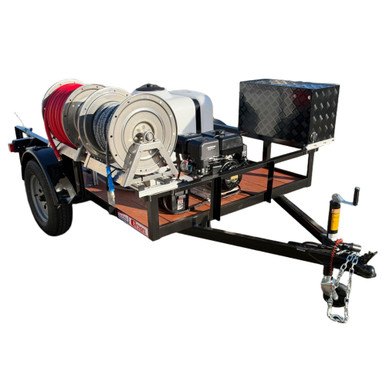
Our recommendation is the ProTool Utility Pressure Washing Trailer, priced under $10,000.
Here's what you're getting:
| Feature | ProTool Utility Pressure Washing Trailer |
|---|---|
| Price | Under $10,000 |
| Pressure washer flow | 5 GPM |
| Pressure | 3,000 PSI |
| Water tank | 100 gallons |
| Trailer GVWR | 3,000 lb |
| Trailer brakes | Included |
| Engine starting | Electric start |
| Pressure washing hose | 300 ft of 3/8-inch hose |
| Incoming water hose | 150 ft of 3/4-inch hose |
| Hose reels | Two electric stainless steel reels |
| Battery charger | 110V charger |
| Electrical connection | Recessed plug in utility lockbox |
That's a legitimate professional pressure washing setup with features that make a difference on real jobsites.
Five GPM. Two electric reels. A trailer with brakes. Under ten grand. Damn right.
ProTool Utility Pressure Washing Trailer
$9,845.70
ProTool 5×8 Utility Pressure Washing Trailer — 5 GPM / 3,500 PSI Everything You Need. Nothing You Don't. Not every job calls for a massive… read more
1. GPM vs. PSI: Stop Shopping for the Biggest Number
One of the biggest mistakes contractors make when shopping for a pressure washing trailer is focusing almost entirely on PSI.
You'll see machines advertised at 3,000, 3,500, or 4,000 PSI, and it's easy to assume the highest number must be the best.
Not necessarily.
PSI: Cleaning Pressure
PSI stands for pounds per square inch. It measures the pressure delivered by the pressure washer.
Pressure helps remove stubborn contaminants, but more isn't always better.
Excessive pressure can damage concrete, wood, painted surfaces, siding, and other materials. Proper nozzle selection, cleaning methods, and surface conditions matter.
GPM: Cleaning Volume
GPM stands for gallons per minute. It measures how much water the pressure washer delivers.
More flow generally improves rinsing capability and supports larger, appropriately sized surface cleaners.
For contractors cleaning driveways, sidewalks, patios, and commercial flatwork, GPM is a major factor in productivity.
A machine that delivers more usable water volume can often complete work more efficiently than a smaller machine operating at higher pressure.
What GPM Should a Professional Pressure Washing Trailer Have?
| Flow rate | Best application | ProTool recommendation |
|---|---|---|
| Under 4 GPM | Detailing and lighter-duty cleaning | Generally undersized for production exterior cleaning |
| 4 GPM | Entry-level professional work | Our minimum recommended starting point |
| 5–5.5 GPM | Residential driveways, patios, sidewalks, property cleaning | Excellent residential contractor range |
| 8 GPM | Established residential and commercial operations | Our preferred all-around professional size |
| 10.5 GPM | High-production commercial cleaning | For contractors needing greater output |
| Dual machines | Multiple operators and specialized operations | For larger, more complex systems |
Why We Chose 5 GPM at 3,000 PSI
The ProTool Utility Pressure Washing Trailer uses a 5 GPM, 3,000 PSI pressure washer.
That's a strong combination for residential cleaning.
Five GPM provides useful water volume for rinsing and compatible surface cleaners, while 3,000 PSI offers substantial cleaning pressure for appropriate applications.
It also avoids unnecessarily chasing higher PSI numbers that may not improve productivity on typical residential jobs.
Of course, 5 GPM isn't the biggest machine we build.
For larger commercial projects, we often recommend stepping up to 8 GPM or beyond.
But for a residential contractor who wants a professional trailer without investing in a substantially larger system, 5 GPM makes a lot of sense.
The ProTool Way: Buy enough pressure washer to do the job efficiently. Don't pay extra just to brag about a number on the spec sheet.
2. Water Tank Capacity: Why 100 Gallons Can Be a Smart Choice
When comparing pressure washing trailers, buyers often focus on water tank capacity.
A 300-gallon tank sounds better than a 100-gallon tank, right?
Not automatically.
The right tank size depends on how the trailer will be used.
How Much Does Water Actually Weigh?
Water weighs approximately 8.34 pounds per gallon.
| Water capacity | Water weight |
|---|---|
| 100 gallons | 834 lb |
| 200 gallons | 1,668 lb |
| 300 gallons | 2,502 lb |
| 500 gallons | 4,170 lb |
That's just the water.
It doesn't include the trailer, pressure washer, engine, fuel, reels, hoses, tools, or accessories.
And those weights add up quickly.
Why the ProTool Trailer Uses a 100-Gallon Tank
The ProTool Utility Pressure Washing Trailer includes a 100-gallon water tank.
For residential contractors working at properties with adequate water access, this provides a useful buffer between the incoming water supply and the pressure washer.
A buffer tank helps accommodate variations in supply flow.
It also provides some reserve water when incoming supply temporarily falls behind demand.
At 5 GPM, 100 gallons represents approximately 20 minutes of theoretical continuous spraying without incoming water, assuming the entire tank volume is usable.
In normal operation, the incoming water supply replenishes the tank as you work.
What Happens if the Customer's Water Supply Is Too Slow?
Let's say your pressure washer consumes 5 GPM, but the available water supply only delivers 4 GPM.
You're losing approximately 1 gallon from the tank for every minute the pressure washer operates at full flow.
With a full 100-gallon usable reserve, that would theoretically give you about 100 minutes of continuous spraying before the reserve was exhausted.
Real-world operating time depends on usable tank volume, inlet flow, trigger time, and system design.
The key lesson?
A buffer tank gives you breathing room. It doesn't create an unlimited water supply.
When Should You Buy a Larger Tank?
Consider additional water capacity when:
- Cleaning properties without reliable water access
- Working at remote commercial or industrial sites
- Running higher-flow pressure washers
- Supporting multiple operators
- Performing work that requires substantial onboard water storage
But remember: larger tanks require adequate trailer capacity and proper weight distribution.
More water isn't always better. The right amount of water is better.
3. Trailer GVWR and Brakes: Don't Ignore the Equipment Carrying Your Equipment
A pressure washing trailer is only as useful as the platform carrying it.
And when you're hauling water, engines, reels, and tools, trailer construction matters.
The ProTool Utility Pressure Washing Trailer has a 3,000-lb gross vehicle weight rating (GVWR) and includes trailer brakes.
What Does 3,000-lb GVWR Mean?
GVWR is the maximum rated weight of the loaded trailer.
It includes everything:
- The trailer itself
- Pressure washer and engine
- Water in the tank
- Hose reels and hoses
- Fuel
- Tools and accessories
- Any other equipment carried on the trailer
A full 100-gallon tank contributes approximately 834 pounds.
That means the remaining allowable weight must accommodate the trailer and all its other components.
GVWR is not the same as payload capacity. To determine available payload, you need the trailer's actual empty or as-equipped weight.
Before towing, verify the fully loaded weight, axle and tire ratings, tongue weight, hitch capacity, and tow-vehicle ratings.
Why Trailer Brakes Matter
Trailer brakes help provide additional braking capability when properly installed, adjusted, and used with a compatible tow vehicle.
That's particularly valuable when transporting equipment and water.
Braking requirements vary by state and trailer configuration, but we believe brakes are a worthwhile feature on a professional equipment trailer.
It's one of those details that might not make the most exciting product photo—but absolutely matters in the real world.
The ProTool Way: A professional pressure washing trailer should be designed for the road, not just the jobsite.
4. Hose Management: The Feature You'll Appreciate Every Single Day
Here's where the ProTool Utility Pressure Washing Trailer really starts to separate itself from a basic equipment package.
Two electric stainless steel hose reels.
One for the pressure washing hose.
One for the incoming water supply.
Both included in a trailer priced under $10,000.
300 Feet of 3/8-Inch Pressure Washing Hose
The trailer includes 300 feet of 3/8-inch pressure washing hose on an electric stainless steel reel.
That's substantial working reach for residential properties.
You can park the trailer in a convenient location and access areas around the property without constantly repositioning your equipment.
Long hose runs do create some pressure loss, so hose diameter and length should always be considered when designing the system.
But properly sized hose capacity is a major convenience advantage.
150 Feet of 3/4-Inch Incoming Water Hose
This is the feature we really want contractors to notice.
The trailer includes 150 feet of 3/4-inch incoming-water hose on its own electric stainless steel reel.
Some budget-oriented trailer packages leave the inlet hose as a separate item to carry, deploy, and coil by hand.
We don't think that's the ideal way to work.
With a dedicated inlet reel, your water supply hose has a permanent, organized location on the trailer.
When you arrive at a property, deploy the hose and connect to the available water supply.
When you're finished, use the electric reel to retrieve it.
No tangled pile of hose in the truck bed.
No hand-coiling 150 feet of supply hose at the end of a long day.
Why Electric Reels Are Worth Having
Manual reels can work perfectly well.
But electric reels reduce the effort involved in hose retrieval.
That convenience becomes more valuable as the number of jobs increases.
Imagine completing four residential jobs in a day.
That's four deployments and four retrievals of your pressure hose, plus the same routine for your incoming-water hose.
Now multiply that across an entire season.
Those repetitive tasks add up.
Electric reels won't clean a driveway faster by themselves, but they can make setup and breakdown more efficient.
And a well-organized trailer makes it easier to keep equipment ready for the next job.
Why Stainless Steel?
Stainless steel offers corrosion resistance in wet operating environments.
That's useful for equipment routinely exposed to water, cleaning chemicals, and outdoor conditions.
It isn't immune to corrosion or chemical damage, but it's a solid material choice for professional hose management.
And the larger reel design provides the capacity needed for the included hose lengths.
Three hundred feet of pressure hose. One hundred fifty feet of inlet hose. Two electric reels.
All your hoses have a home. All your winding gets done for you.
5. Electric Start and Battery Charging: Professional Convenience Matters
The ProTool Utility Pressure Washing Trailer includes an electric-start engine.
For a contractor using equipment repeatedly throughout the day, that's a welcome convenience.
Instead of relying on a recoil starter, the engine can be started electrically when the battery and starting system are in proper working condition.
But electric start introduces another consideration: battery maintenance.
Integrated 110V Battery Charger
The trailer includes a 110V battery charger with a recessed electrical connection located in a utility lockbox.
When suitable shore power is available, the charger provides a convenient way to maintain the starting battery according to the battery and charger's requirements.
Park the trailer at your shop, connect it to appropriate electrical power, and maintain the battery between jobs.
The pressure washer itself is gasoline-powered; the 110V connection is for battery charging, not for running the pressure washer.
Why Include a Utility Lockbox?
Because charging equipment and electrical connections deserve an organized, protected location.
The utility lockbox helps keep those components together rather than leaving the contractor to improvise a charging setup.
It's a small feature.
But a professional system is often defined by how well the small details have been handled.
A trailer that costs less shouldn't feel like a trailer that was built with less thought.
6. What Should You Expect From a Pressure Washing Trailer Under $10,000?
When comparing pressure washing trailers, look beyond the advertised PSI and price.
Here's a practical checklist.
| Buying consideration | What to look for |
|---|---|
| Pressure washer | Appropriate GPM and PSI for the intended applications |
| Pump and engine | Professional components matched to the workload |
| Water tank | Enough usable capacity for the available supply |
| Trailer | Appropriate GVWR, axle ratings, and construction |
| Trailer brakes | Suitable braking system for the configuration |
| Pressure hose | Sufficient length and diameter |
| Inlet hose | Properly sized and conveniently stored |
| Hose reels | Manual or electric, with adequate capacity |
| Battery system | Reliable starting and practical charging |
| Plumbing | Proper sizing, routing, and service access |
| Equipment layout | Easy operation, inspection, and maintenance |
| Support | Clear warranty terms and access to help when needed |
Also ask exactly what's included in the advertised price.
Does the trailer include the hoses?
Does it include the reels?
What about the battery, nozzles, surface cleaner, or other accessories?
Is assembly included?
What are the freight charges?
A lower-priced package isn't necessarily a better value if you have to purchase and install a substantial amount of additional equipment.
Compare complete systems—not just price tags.
7. Our Recommendation: ProTool Utility Pressure Washing Trailer
If you're looking for a professional pressure washing trailer under $10,000, the ProTool Utility Pressure Washing Trailer is built for exactly this kind of purchase.
At under $10,000, it provides a capable 5 GPM pressure washing system, a 100-gallon water tank, a braked trailer, and a level of hose management that makes everyday operation easier.
ProTool Utility Pressure Washing Trailer — At a Glance
| Specification | Details |
|---|---|
| Price | Under $10,000 |
| Pressure washer | 5 GPM / 3,000 PSI |
| Water storage | 100 gallons |
| Trailer rating | 3,000-lb GVWR |
| Trailer brakes | Yes |
| Starting system | Electric start |
| Pressure hose | 300 ft × 3/8 in |
| Water inlet hose | 150 ft × 3/4 in |
| Hose reels | Two electric stainless steel reels |
| Battery charging | 110V charger |
| Electrical access | Recessed plug in utility lockbox |
Who Is This Trailer Best For?
New residential pressure washing businesses
Contractors who want a professional trailer-based system without jumping straight into a larger commercial build.
Driveway and sidewalk cleaning contractors
Operators who need useful water flow, substantial working hose length, and organized equipment for repeated residential jobs.
Contractors upgrading from portable pressure washers
Business owners who are tired of loading equipment into a truck, unloading at every job, and dealing with loose hoses.
Small exterior-cleaning operations
Contractors who want a dedicated pressure washing platform with convenient starting, hose management, and battery maintenance.
When Would We Recommend Something Bigger?
If you're primarily cleaning large commercial properties, parking structures, industrial facilities, or other high-production environments, we'd look closely at an 8 GPM system.
And for heavy commercial work, 10.5 GPM or dual pressure washers may make more sense.
The ProTool Utility Pressure Washing Trailer isn't intended to replace every commercial configuration.
It's designed to deliver practical professional capability at an accessible price.
The right equipment isn't always the biggest equipment. It's the equipment that makes sense for your business.
Explore the ProTool Utility Pressure Washing Trailer
8. Should You Buy a Pressure Washing Trailer or a Truck-Mounted Skid?
A pressure washing trailer isn't automatically the best platform for every contractor.
A truck-mounted skid can be an excellent alternative.
Advantages of a Pressure Washing Trailer
- Dedicated equipment platform
- Separate from the tow vehicle
- Room for tanks, reels, and accessories
- Potential for expansion within rated capacity
- Can be moved by another appropriately equipped tow vehicle
- Keeps equipment off the truck bed
Advantages of a Truck-Mounted Skid
- No separate trailer to tow
- Easier maneuvering in some residential areas
- More compact overall footprint
- Potentially easier parking and storage
- Convenient for contractors who already have a suitable work truck
The right platform depends on your vehicle, your available storage space, the work you're performing, and how much equipment you need.
A contractor cleaning residential driveways in tight neighborhoods may prefer a compact truck skid.
Another contractor may prefer a trailer because it keeps the truck available for other tasks.
Both approaches can work extremely well.
We build both. Because the right answer depends on the operator—not which platform happens to be sitting on the showroom floor.
9. Five Mistakes to Avoid When Buying an Affordable Pressure Washing Trailer
Mistake #1: Buying Based on PSI Alone
A 4,000 PSI machine isn't automatically more productive than a 3,000 PSI machine.
Flow rate, nozzle selection, surface-cleaner compatibility, and the actual cleaning application matter.
For residential contractors, a properly equipped 5 GPM system can be a much better working tool than a smaller, higher-pressure machine.
Mistake #2: Ignoring Water Supply Requirements
A 5 GPM pressure washer needs a sufficient water supply.
A buffer tank can help manage temporary differences between supply and demand, but it cannot compensate indefinitely for inadequate incoming flow.
Understand the water requirements before buying.
Mistake #3: Forgetting About Loaded Trailer Weight
A full 100-gallon tank weighs approximately 834 pounds.
Add the trailer, equipment, fuel, and accessories, and the total weight increases quickly.
Never assume a trailer can safely carry a full tank simply because the tank fits on the frame.
Mistake #4: Overlooking Hose Management
It's easy to focus on the pressure washer and overlook the hoses.
But hoses are used at every single job.
A dedicated inlet hose reel and electric pressure hose reel can improve organization and make repetitive setup and breakdown less frustrating.
Mistake #5: Buying Equipment You'll Immediately Outgrow
A budget is important.
But so is your business plan.
If you're planning to move into large commercial work within the next few months, buying a smaller residential trailer might not be the most economical decision.
On the other hand, if you're building a residential cleaning operation, there's no reason to buy a massive industrial system just because it's bigger.
Buy for the work you're doing—and the work you're realistically growing into.
10. Is a $10,000 Pressure Washing Trailer Worth the Investment?
For many contractors, yes.
A professional trailer can provide a dedicated operating platform, organized equipment, practical water storage, and a more efficient setup process.
But whether the investment pays off depends on the business.
Consider how many jobs you'll complete, your average revenue per job, operating expenses, maintenance costs, and how much time the equipment can realistically save.
For example, if a trailer's convenience saves 15 minutes per job across four jobs per day, that's an hour of operator time.
That doesn't automatically translate into an additional hour of billable work, but it can create more scheduling flexibility and reduce repetitive labor.
Over time, equipment that's easier to operate can make a meaningful difference.
Don't Confuse Cheap With Good Value
A $7,000 trailer that requires additional reels, hoses, charging equipment, and installation may end up costing substantially more than its advertised price.
A more complete system can sometimes offer better overall value.
That's why we believe contractors should compare the entire package.
Look at what the trailer does, how it's equipped, and how it will function in daily operation.
The best deal isn't always the lowest price. It's the most useful equipment for the money.
Why ProTool? Because Details Matter.
At ProTool, we design and build professional cleaning systems around how contractors actually work.
That means thinking beyond engines and pumps.
We consider equipment layout, fabrication, plumbing, electrical integration, hose management, access for maintenance, and how the complete system operates.
Our builds are assembled and tested as integrated systems before shipment.
We also provide long-term support to help customers diagnose problems, find solutions, and keep their equipment working. Parts and services may be billable depending on the circumstances.
Qualifying ProTool skids, carts, and systems are backed by our lifetime warranty, subject to terms and exclusions. Coverage for third-party components and trailers may differ.
The goal is straightforward.
Build equipment that performs, makes sense to operate, and holds up to the demands of professional work.
That's the ProTool Way.
Ready to Put a Real Pressure Washing Trailer to Work?
You don't need a massive budget to get into a professional trailer-mounted pressure washing system.
For for under $10,000, the ProTool Utility Pressure Washing Trailer delivers:
- 5 GPM at 3,000 PSI
- 100 gallons of water storage
- 3,000-lb GVWR trailer with brakes
- 300 feet of pressure washing hose
- 150 feet of incoming-water hose
- Two electric stainless steel hose reels
- Electric-start engine
- Integrated battery charging
A complete, operator-focused pressure washing trailer at a price that stays under $10,000.
Shop the ProTool Utility Pressure Washing Trailer
Need something larger, with more flow, hot water, soft washing, or a custom equipment layout?
Request a Custom ProTool Build
Professional equipment. Practical engineering. No unnecessary nonsense.
That's the ProTool Way.
FAQs
What is the best pressure washing trailer under $10,000?
A good pressure washing trailer under $10,000 should include a professional pressure washer, appropriate water capacity, a properly rated trailer, and practical hose management. The ProTool Utility Pressure Washing Trailer offers 5 GPM at 3,000 PSI, a 100-gallon tank, trailer brakes, and two electric stainless steel hose reels for $9,845.70.
A budget trailer doesn't have to be bare-bones.
Is 5 GPM enough for a professional pressure washing business?
Yes. A 5 GPM pressure washer is a strong choice for residential driveways, sidewalks, patios, and general property cleaning when properly equipped. Contractors focused on large commercial projects may benefit from moving to 8 GPM or more.
Five GPM can make money. Eight GPM can help you tackle bigger work.
Is 3,000 PSI enough to clean residential driveways?
Yes. A properly configured 3,000 PSI pressure washer can clean many residential concrete driveways effectively with appropriate nozzles, cleaning methods, and surface-cleaner equipment. Actual requirements depend on the concrete's condition and the contaminants being removed.
Don't chase PSI for bragging rights. Chase results.
How much water should a pressure washing trailer carry?
The right tank capacity depends on pressure washer flow, incoming water supply, and the job. A 100-gallon buffer tank can be practical for a 5 GPM residential system with reliable water access, while remote jobs may require more storage.
Carry the water you need—not weight you don't.
How long will a 100-gallon tank last with a 5 GPM pressure washer?
A 100-gallon tank provides approximately 20 minutes of theoretical continuous spraying at 5 GPM without incoming water, assuming all 100 gallons are usable. With a suitable incoming supply, the tank can be replenished during operation.
A buffer tank buys you time. It doesn't make water out of thin air.
Are electric hose reels worth it on a pressure washing trailer?
Electric hose reels make hose retrieval more convenient and reduce manual winding during setup and breakdown. Having a dedicated inlet hose reel is particularly useful for contractors completing multiple jobs each day.
Less time winding hoses. More time getting paid.
Should a pressure washing trailer have brakes?
Trailer brakes can improve towing control and reduce the braking demand on the tow vehicle when properly installed and operated. Legal requirements vary by jurisdiction and trailer configuration, so always verify the applicable rules and loaded trailer weight.
A professional trailer should be ready for the road, not just the driveway.
Does ProTool sell a complete pressure washing trailer for under $10,000?
Yes. The ProTool Utility Pressure Washing Trailer is priced at $9,845.70 in this article and includes a 5 GPM, 3,000 PSI pressure washer, 100-gallon tank, braked trailer, two electric stainless steel hose reels, and integrated battery charging. Confirm current pricing and package details before purchasing.
Five GPM. Two electric reels. Under ten grand. Damn right.