How to Design a Custom Pressure Washing Truck Skid: Bed Size, Payload & Equipment Layout
Table of Contents
- How to Design a Custom Pressure Washing Truck Skid: Bed Size, Payload & Equipment Layout
- 1. Start With the Truck, Not the Skid
- 2. Truck Bed Dimensions: Measure Twice, Build Once
- 3. Payload Capacity: The Number That Actually Matters
- 4. Water Weight: The Fastest Way to Overload a Truck
- 5. Weight Distribution: Where You Put the Tanks Matters
- 6. Choosing a Pressure Washer for a Truck Skid
- 7. Adding Soft Washing Without Taking Over the Bed
- 8. Hose Reel Placement: Design Around the Operator
- 9. The Frame: Build a Foundation That Makes Sense
- 10. Service Access: Can You Actually Work on the Equipment?
- 11. Hot Water and Pure Water: When the Build Gets More Complex
- 12. What Does a Well-Designed Truck Skid Look Like?
- 13. Design Your Truck Skid Before You Build It
- Build Around the Truck. Then Build for the Grind.
- FAQs
How to Design a Custom Pressure Washing Truck Skid: Bed Size, Payload & Equipment Layout
A truck bed has limited space. A serious cleaning operation has a lot of equipment. Here's how to make the two work together for a Pressure Washing Truck Skid.
A pressure washing truck skid can turn an ordinary work truck into a complete commercial cleaning rig.
No separate trailer to park. No additional trailer to maneuver through tight properties. Just your truck, your equipment, and the work ahead.
Sounds simple.
Until you start figuring out how to fit a pressure washer, water tanks, hose reels, soft wash equipment, plumbing, and controls into a pickup bed.
And fitting everything is only half the challenge.
You also need to consider payload capacity, weight distribution, service access, and how the equipment operates when you're actually on the job.
At ProTool, we design and manufacture custom truck-mounted cleaning skids for contractors who need serious equipment in a practical footprint.
Here's what goes into designing a pressure washing truck skid that works as well as it looks.
1. Start With the Truck, Not the Skid
Before choosing equipment, identify the truck that's going to carry it.
A half-ton pickup, three-quarter-ton pickup, and one-ton truck can have very different payload capacities.
Even trucks in the same model family can have significantly different ratings depending on their configuration.
Cab style, drivetrain, engine, bed length, factory options, and installed accessories can all affect available payload.
That's why choosing a skid based solely on the truck's model name is a mistake.
You need to know the actual truck's ratings and dimensions.
Start with:
- The truck's rated payload capacity
- Gross Vehicle Weight Rating (GVWR)
- Front and rear Gross Axle Weight Ratings (GAWR)
- Usable bed length and width
- Clearance between the wheel wells
- Bed height and tailgate configuration
- Existing accessories, racks, or toolboxes
The truck's door-jamb certification and tire/loading labels provide important vehicle-specific information.
The best skid design starts with the truck's actual capacity—not what someone on the internet says their truck can haul.
2. Truck Bed Dimensions: Measure Twice, Build Once
A pressure washing skid needs to fit the usable space inside the truck bed.
That sounds obvious, but truck bed measurements aren't always as straightforward as the advertised bed length.
A nominal 6.5-foot bed doesn't mean you have a perfectly rectangular 6.5-foot workspace.
Wheel wells, bed contours, tie-down locations, tailgate openings, and existing accessories can all affect usable space.
Measure:
Bed length: The usable distance from the front bulkhead to the tailgate area.
Bed width: The available width at the locations where equipment will sit.
Wheel-well clearance: The width between the wheel wells and their position along the bed.
Bed height: The height of the bed rails and any clearance restrictions created by racks or covers.
Access points: Where operators can reach equipment, hose reels, valves, and service components.
Also think about what needs to extend above the bed rails.
A skid may fit perfectly on the floor but interfere with a ladder rack, toolbox, tonneau cover, or other equipment.
If you're designing around an existing truck, the truck gets the final say.
3. Payload Capacity: The Number That Actually Matters
A truck skid doesn't just need to fit.
The truck needs to be able to carry it.
Payload is the amount of weight the truck can carry within its ratings, including occupants, cargo, equipment, and other applicable loads.
For a pressure washing skid, that means accounting for much more than the empty frame.
Your loaded system may include:
- Skid frame and mounting hardware
- Pressure washer and engine
- Water tanks and their contents
- Soft wash equipment and chemicals
- Hose reels and hoses
- Batteries and electrical equipment
- Fuel
- Tools and accessories
- Driver, passengers, and other cargo
It's easy to underestimate the total.
Especially when you start adding water.
4. Water Weight: The Fastest Way to Overload a Truck
Water is heavy.
And a pressure washing truck skid can carry a lot of it.
At ordinary conditions, water weighs approximately 8.34 pounds per gallon.
Here's what that means in a pickup bed.
| Water Capacity | Approximate Water Weight |
|---|---|
| 50 gallons | 417 lb |
| 100 gallons | 834 lb |
| 150 gallons | 1,251 lb |
| 200 gallons | 1,668 lb |
| 300 gallons | 2,502 lb |
These figures cover the water alone. They do not include tanks, frames, equipment, fuel, chemicals, or occupants.
A 200-gallon water tank can consume a substantial portion of a pickup's available payload before the rest of the cleaning system is considered.
And chemicals can add even more weight.
Sodium hypochlorite solutions may weigh more per gallon than water, depending on concentration.
That's why tank capacity should be selected around both the cleaning operation and the carrying vehicle.
Bigger Tanks Aren't Automatically Better
If you regularly work at properties with a dependable water supply, you may not need to carry enough water for an entire job.
A suitable buffer tank and incoming supply arrangement may be a better fit.
If you're working at locations without reliable water access, onboard storage becomes more important.
But the truck's payload and axle ratings still set the limits.
Water capacity is an operating decision and a vehicle engineering decision. You can't separate the two.
5. Weight Distribution: Where You Put the Tanks Matters
Two pressure washing truck skids can carry the same equipment and still load the truck differently.
That's because weight placement matters.
Heavy water tanks, engines, and other equipment affect how the load is distributed between the front and rear axles.
Placing too much weight behind the rear axle can increase rear axle loading and reduce load on the front axle.
That can affect handling, braking behavior, and vehicle stability.
For this reason, heavy components generally deserve careful placement closer to the truck's load-bearing structure and within the appropriate axle-loading plan.
But there's no universal rule that every tank should go in one exact position.
The correct layout depends on the truck's wheelbase, axle ratings, bed dimensions, and complete loaded equipment package.
Don't Forget Changing Fluid Levels
A skid's weight distribution can change throughout the day.
Water gets used.
Chemical tanks empty at different rates.
Fuel levels change.
That means a design should account for more than one loading condition.
A rig that's appropriately balanced with full tanks still needs to operate safely as those tanks are depleted.
A skid shouldn't just fit the truck. It needs to work with the truck.
6. Choosing a Pressure Washer for a Truck Skid
Once the vehicle's physical and weight limits are understood, you can start selecting cleaning equipment.
ProTool offers truck skid configurations with commercial pressure washers in different flow ranges, including 5.5 GPM, 8 GPM, and 10.5 GPM systems.
The right choice depends on your cleaning applications, available water supply, and the supporting equipment.
A higher-flow pressure washer can improve productivity in suitable applications, but it also increases water demand.
For example, a 100-gallon tank provides approximately:
- 18 minutes at 5.5 GPM
- 12.5 minutes at 8 GPM
- 9.5 minutes at 10.5 GPM
These are theoretical continuous-operation figures without incoming water and assume the full tank volume is usable.
If the truck is frequently connected to a suitable external water source, onboard storage requirements may be different from a rig that must operate independently.
The important thing is to select the pressure washer and water system together.
Explore ProTool Commercial Pressure Washers →
7. Adding Soft Washing Without Taking Over the Bed
A combination pressure washing and soft washing truck skid can support multiple exterior cleaning services from one vehicle.
But adding a soft wash system means accounting for additional equipment.
Depending on the configuration, that may include:
- A 12V, BPX25, or P40 soft wash pump
- Separate sodium hypochlorite and surfactant tanks
- Chemical metering equipment
- Chemical-compatible plumbing
- Dedicated hose reels and controls
The BPX25 and P40 offer different advantages.
BPX25: Approximately 7 GPM, with strong reach and cleaning performance while delivering less solution for greater control over chemical application. An excellent fit for residential soft washing.
P40: Approximately 11 GPM, offering comparable reach with substantially more solution volume for faster rinsing and larger commercial applications.
Both can serve contractors handling a mix of residential and commercial work.
The challenge in a truck bed is integrating that equipment without sacrificing essential access or exceeding the vehicle's capacity.
Chemical tanks need suitable mounting and containment considerations, and components exposed to sodium hypochlorite need compatible materials.
Explore ProTool Soft Wash Pumps & Systems →
8. Hose Reel Placement: Design Around the Operator
Hose reels are some of the most frequently used components on a pressure washing truck skid.
Their placement can make a huge difference in how the rig operates.
Think about where you normally stand when deploying and retrieving hose.
Do you work from the rear of the truck?
From the curbside?
Do you need to keep the tailgate closed?
Will you be using a ladder rack or other accessories?
The reel layout should support the way your crew works.
Manual or Electric Reels?
Manual hose reels are straightforward and require no electric drive system.
Electric hose reels can reduce the physical effort of retrieving long hose runs.
For crews deploying and recovering hundreds of feet of hose throughout the day, electric reels may be worth considering.
Keep the Plumbing Accessible
Hose reels need adequate clearance for hose movement, connections, swivels, and maintenance.
Don't bury important fittings behind a tank where nobody can reach them.
A clean-looking skid is nice. A skid that's easy to operate is better.
Shop ProTool Hoses & Hose Reels →
9. The Frame: Build a Foundation That Makes Sense
The skid frame is what ties the equipment package together.
At ProTool, our standard skid construction uses an all-aluminum welded base with a bolt-together frame structure.
That approach provides a purpose-built mounting foundation while allowing components and frame elements to be integrated into the finished design.
The frame needs to support the equipment, loaded tanks, and mounting arrangement.
But it also needs to be serviceable.
Equipment shouldn't be trapped behind permanent structural elements that make routine maintenance unnecessarily difficult.
And the skid needs to be properly secured to the vehicle using a mounting arrangement suitable for the expected loads and the truck's structure.
Simply placing a heavy skid in the bed isn't enough.
The foundation matters because everything else depends on it.
10. Service Access: Can You Actually Work on the Equipment?
A truck bed is a tight workspace.
And a pressure washing skid contains equipment that will eventually need maintenance.
Engines need service.
Pumps need inspection.
Filters need attention.
Batteries and electrical connections need access.
Hose reel swivels, valves, and plumbing fittings may need replacement.
Before finalizing the layout, ask whether those components can be reached without removing half the skid.
Consider:
- Engine oil and filter access
- Pump maintenance and inspection
- Battery access
- Plumbing connections and shutoff valves
- Chemical tank filling and service
- Hose reel connections
- Electrical distribution and circuit protection
Good service access doesn't make the skid more exciting to look at.
It makes it a lot more practical to own.
11. Hot Water and Pure Water: When the Build Gets More Complex
Some truck skids go beyond basic pressure washing and soft washing.
A hot-water system can add cleaning capability for grease, oils, and other applications where heated water is beneficial.
But it also adds burner equipment, fuel storage, exhaust considerations, and additional space requirements.
A ProTool HydroPanel pure water system can support water-fed pole window cleaning or solar panel cleaning applications.
That adds filtration equipment, plumbing, power requirements, and potentially separate purified-water storage.
Both capabilities can be integrated into suitable truck builds.
The question is whether the vehicle has the space, payload, and supporting equipment capacity to accommodate them.
When the equipment package becomes too large for a practical pickup-bed installation, a larger truck or different platform may be the better choice.
Explore ProTool Pure Water Systems →
12. What Does a Well-Designed Truck Skid Look Like?
There isn't one perfect pressure washing truck skid for every contractor.
But three common approaches help illustrate the differences.
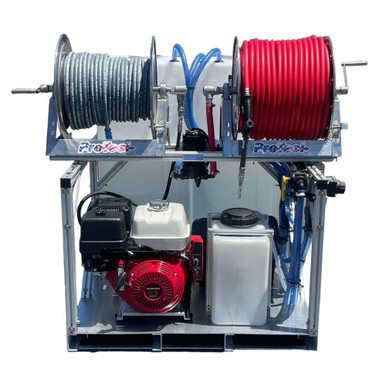
The Compact Pressure Washing Truck Skid
Best for: Contractors focused primarily on pressure washing.
A practical configuration may include a commercial pressure washer, water buffer tank, hose reels, plumbing, and controls.
The goal is to keep the system relatively straightforward while maximizing usable truck-bed space.
Pressure Washing & Soft Washing Compact Skid
$10,640.00
ProTool Pressure Washing & Soft Washing Compact Skid Professional Pressure Washing & Soft Washing Performance That Fits Almost Any Vehicle The ProTool Pressure Washing &… read more
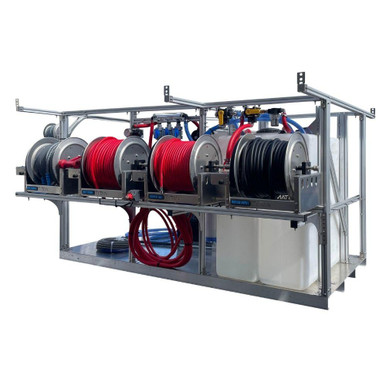
The Pressure Washing + Soft Washing Truck Skid
Best for: Contractors who offer house washing, roof cleaning, driveways, and other exterior cleaning services.
This combines pressure washing equipment with a dedicated soft wash pump, chemical storage, metering, and hose reels.
The challenge is balancing the additional capabilities against the truck's payload and available space.
House Wash & Window Cleaning Skid
$30,498.40
ProTool House Wash & Window Cleaning Skid — Pressure Washing, Soft Washing & Pure Water One Skid. Three Cleaning Systems. The Whole Damn House. Siding?… read more
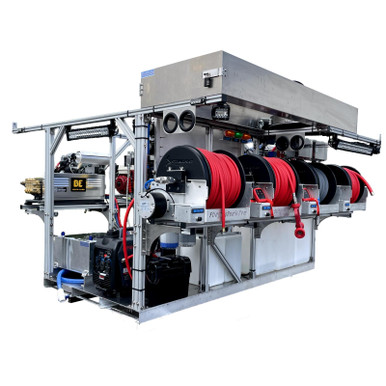
The Multi-Service Commercial Truck Skid
Best for: Contractors who need several cleaning systems in one vehicle.
Depending on the truck and configuration, this may include pressure washing, soft washing, hot water, pure water, electric reels, and remote controls.
This type of build demands more careful attention to equipment placement, service access, and loaded vehicle weight.
The goal isn't to cram everything into the bed.
It's to build the most useful system the vehicle can properly support.
Commercial Hot Water Pressure Washing & Soft Washing Truck Skid
$46,477.60
ProTool Commercial Hot Water Pressure Washing & Soft Washing Truck Skid The ProTool Hot Water Pressure Washing & Soft Washing Truck Skid is a fully… read more
13. Design Your Truck Skid Before You Build It
Once you understand the truck's limitations and the equipment you need, it's time to put the pieces together.
The ProTool Build Configurator lets you select a truck skid platform, choose available pressure washing and soft washing equipment, explore upgrades, and see a live estimated price as you build.
You can compare equipment combinations, save your configuration privately, and submit it for ProTool's engineering review when you're ready.
Final vehicle fitment, mounting, and load suitability need to be confirmed for the actual truck.
DESIGN YOUR CUSTOM PRESSURE WASHING TRUCK SKID →
Have an unusual truck configuration or specialized equipment requirement? REQUEST A CUSTOM BUILD →
Build Around the Truck. Then Build for the Grind.
A pressure washing truck skid should make your business more capable, not make your truck harder to operate.
Start with the vehicle's real dimensions and payload.
Choose water storage that makes sense for the work.
Position heavy equipment with weight distribution in mind.
Arrange hose reels and controls around the operator.
And make sure the equipment can actually be serviced after it's installed.
Because a professional truck skid isn't just a pressure washer in a pickup bed.
It's a complete cleaning system designed to work with the truck carrying it.
BUILD & PRICE YOUR PROTOOL TRUCK SKID →
ProTool. Built for the Grind.
FAQs
What is a pressure washing truck skid?
A pressure washing truck skid is a self-contained commercial cleaning equipment system mounted in a truck bed. It typically combines a pressure washer, water storage or supply, hose reels, plumbing, and controls on a purpose-built frame.
Can I put a pressure washing skid in a pickup truck?
Yes, provided the skid fits the truck's usable bed dimensions and the complete loaded system stays within the vehicle's weight and axle ratings. The mounting arrangement must also be appropriate for the truck and equipment.
How much does a pressure washing truck skid weigh?
Weight varies based on the frame, pressure washer, tanks, hoses, chemicals, and additional equipment. Water alone weighs approximately 8.34 pounds per gallon, so a 200-gallon tank holds about 1,668 pounds of water before accounting for the rest of the system. Truck Skids weigh anywhere from 1300 lbs to 4,500 lbs fully loaded. Commercial cleaning rigs can reach 10,000 lbs or more on flatbeds and trailers.
What size truck do I need for a pressure washing skid?
The appropriate truck depends on the complete skid weight, fluid capacity, bed dimensions, and vehicle-specific payload and axle ratings. A larger truck may be necessary for systems carrying substantial water or multiple cleaning systems.
How much water should a truck-mounted pressure washer carry?
Water storage depends on the pressure washer's flow rate, incoming water availability, operating time, and available payload. A suitable buffer tank may be sufficient when reliable job-site water is available, while remote work may require more onboard storage.
Is a truck skid better than a pressure washing trailer?
A truck skid can be convenient when you want an integrated cleaning vehicle without towing a separate trailer. A trailer may offer more room for equipment and storage. The best choice depends on the work, vehicle capacity, parking requirements, and operating preferences.
What is the best way to arrange hose reels on a truck skid?
Hose reels should be positioned for convenient access while maintaining clearance for hoses, plumbing, and maintenance. Rear-facing and curbside-accessible arrangements may work well depending on the truck and operator workflow.