Why Do Pressure Washing Trailers Cost So Much? Here's What You're Paying For
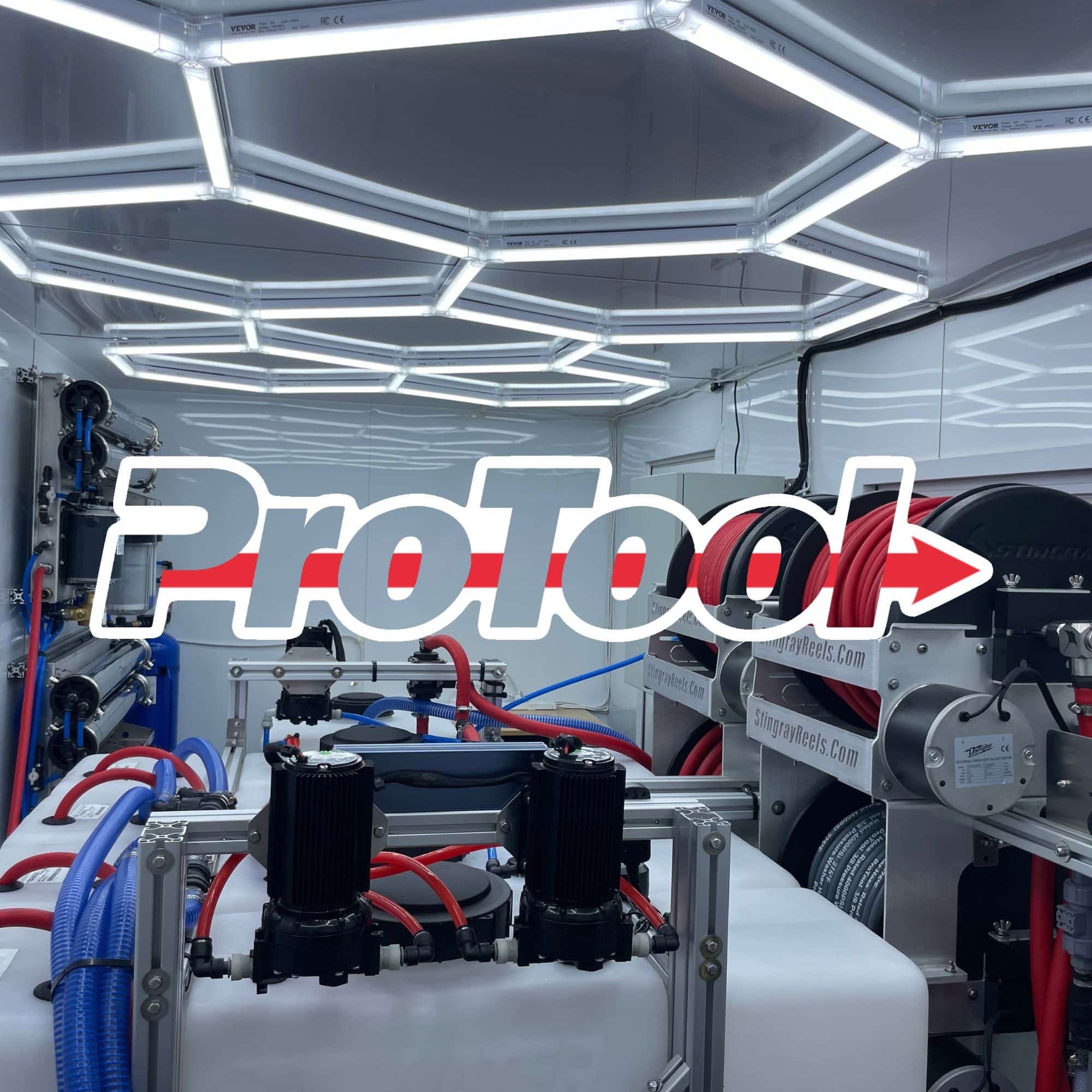
Table of Contents
- What Actually Goes Into a Commercial Pressure Washing Trailer?
- The Pressure Washer: More Flow Changes the Whole System
- Hot Water: The Upgrade That Changes What You Can Clean
- Soft Washing: A Pump Is Only Part of the Package
- Water Tanks: You're Paying to Carry Weight
- The Frame: Where a Good Pressure Washing Trailer Starts
- Plumbing: The Part You Don't See Until Something Goes Wrong
- Hose Reels: Cheap Today, Annoying Every Day
- Electrical Systems and Remote Controls: Integration Matters
- Pure Water Systems: Another Service Without Another Rig
- Open Trailer or Enclosed Trailer? Different Tools for Different Jobs
- What Makes One Pressure Washing Trailer More Expensive Than Another?
- The Costs That Don't Show Up on the Equipment List
- Should You Buy a Used Pressure Washing Trailer?
- What to Look for When Buying a Pressure Washing Trailer
- The ProTool Difference: Built Around the Work
- Here's what two actual ProTool pressure washing trailers bring to the table.
- Enough Guessing. Build It. Price It. See for Yourself.
- Built for the Grind. Not Built to Be Cheap.
- FAQs
Why Does a Pressure Washing Trailer Cost So Much? Here's What You're Paying For
Two pressure washing trailers. Similar equipment lists. Thousands of dollars apart. Here's what separates a professional cleaning rig from a collection of parts bolted to a trailer.
Shopping for a commercial pressure washing trailer? You've probably noticed something interesting.
One trailer costs considerably more than another, even though both appear to have the same pressure washer, water tank, and hose reels.
What gives?
Is the more expensive trailer overpriced? Is the cheaper one a screaming deal? Or are you missing something that doesn't show up on the equipment list?
Here's the thing: you can't judge a pressure washing trailer by counting the components bolted to it.
The equipment matters. But so does the way it's mounted, plumbed, wired, controlled, and arranged.
A trailer that looks impressive in a photograph can be a nightmare to operate. And a trailer that costs more up front can make a lot more sense once you understand what's actually included.
At ProTool, we design and manufacture commercial pressure washing trailers, soft wash systems, and complete cleaning rigs for contractors who expect their equipment to earn its keep.
So let's talk about what you're really paying for.
What Actually Goes Into a Commercial Pressure Washing Trailer?
A commercial pressure washing trailer can be a straightforward cold-water cleaning setup or a multi-service rig with several independent systems.
That difference changes everything.
A basic pressure washing trailer might include a commercial pressure washer, water storage, plumbing, and hose reels.
A more advanced build might add:
- Higher-flow pressure washing equipment
- A dedicated soft wash pump and chemical metering system
- Hot-water pressure washing
- HydroPanel RO/DI pure water production
- Electric hose reels
- Skid Nexus remote controls
- Additional tanks, plumbing, and electrical integration
Each addition affects more than the price of an individual component.
It changes how the complete trailer needs to be designed and built.
And that's where comparing pressure washing trailers by equipment lists alone starts to fall apart.
The Pressure Washer: More Flow Changes the Whole System
Let's start with the obvious component.
The pressure washer.
ProTool builds commercial pressure washing systems with options including 5.5 GPM, 8 GPM, and 10.5 GPM configurations.
Those numbers describe water flow, and they matter.
For suitable applications, higher flow can improve rinsing performance and cleaning productivity.
But increasing flow also changes what the rest of the trailer needs to support.
An 8 GPM pressure washer requires a water supply capable of feeding it properly. A 10.5 GPM machine demands even more.
That can influence tank capacity, supply plumbing, hose sizing, and the overall operating plan.
The mistake is looking at a bigger pressure washer as an isolated upgrade.
You're not just buying more GPM. You're building a system that has to support more GPM.
Explore ProTool Commercial Pressure Washers →
Hot Water: The Upgrade That Changes What You Can Clean
A cold-water pressure washing trailer can handle a wide range of exterior cleaning applications.
But some jobs call for heat.
Commercial degreasing, oily equipment, and certain industrial cleaning applications can benefit from hot-water pressure washing.
Adding that capability requires a heating system, burner fuel supply, compatible plumbing, electrical integration, and appropriate exhaust and heat management.
It's not just another accessory.
It's another major system.
For contractors regularly performing grease and oil removal, that additional capability may be well worth the investment.
For contractors primarily cleaning residential driveways and siding, it may not be necessary.
That's an important distinction.
The most expensive option isn't automatically the smartest option. The right option is the one that helps you perform profitable work.
Explore ProTool Hot Water Burners →
Soft Washing: A Pump Is Only Part of the Package
Want to offer roof cleaning, house washing, and other soft washing services?
Then your pressure washing trailer needs more than a pressure washer.
A proper soft wash system involves a pump, chemical-compatible plumbing, storage tanks, delivery hose, and appropriate controls.
Depending on the configuration, it may also include a chemical metering manifold for adjusting water, sodium hypochlorite, and surfactant.
ProTool offers several soft wash pump options, including 12V systems, the BPX25, and the P40.
And here's something worth understanding before you automatically choose the biggest pump.
BPX25: The Residential Killer
The ProTool BPX25 delivers approximately 7 GPM and packs serious spray reach and cleaning performance into a lower-flow system.
Compared with the P40, it moves less solution while delivering comparable practical reach in suitable configurations.
That means greater control over chemical application and the potential to reduce unnecessary chemical consumption and runoff.
For residential roof cleaning, house washing, and contractors who prioritize controlled chemical delivery, the BPX25 is a strong choice.
P40: The Commercial Killer
The ProTool P40 delivers approximately 11 GPM.
It offers comparable reach with substantially more solution volume.
That extra flow is valuable when covering larger areas and when faster rinsing is a priority.
For larger commercial cleaning operations, the P40 can be an excellent fit.
What If You Do Both?
You can't go wrong with either when it's properly matched to the job.
Choose the BPX25 when chemical efficiency and control are the priority.
Choose the P40 when higher flow and faster rinsing matter more.
Don't confuse more gallons with more cleaning power. Sometimes the smarter pump is the one that uses less solution to get the job done.
Explore ProTool Soft Wash Pumps & Systems →
Water Tanks: You're Paying to Carry Weight
Water storage is one of the most misunderstood parts of a pressure washing trailer setup.
A larger tank might sound like an obvious upgrade.
But water is heavy.
| Water Capacity | Approximate Water Weight |
|---|---|
| 100 gallons | 834 lb |
| 200 gallons | 1,668 lb |
| 300 gallons | 2,502 lb |
| 500 gallons | 4,170 lb |
Weights are for water only. Tanks, equipment, chemicals, fuel, and trailer structure add to the total.
Now imagine adding a pressure washer, soft wash equipment, several hose reels, chemical tanks, and all the supporting hardware.
Suddenly, the trailer's axle ratings, tires, brakes, frame, and load distribution become a pretty big deal.
A properly designed pressure washing trailer needs to accommodate the complete loaded system—not just the equipment when all the tanks are empty.
And the biggest tank isn't always the best choice.
If you regularly work at properties with reliable water access, a properly designed buffer system may make more sense than hauling hundreds of extra gallons.
If you work where water isn't available, onboard storage becomes much more important.
Buy the water capacity your operation needs. Then make sure the trailer is actually built to carry it.
The Frame: Where a Good Pressure Washing Trailer Starts
Here's something you won't always appreciate from a product photograph.
The frame.
It's the foundation of the entire cleaning system.
ProTool's standard skid construction uses an all-aluminum welded base with a bolt-together frame structure.
That gives us a purpose-built equipment foundation with a modular approach to integrating the components above it.
The design needs to account for loaded tanks, equipment mounting, service access, and the way the complete system will be used.
But there's another reason the frame matters.
Maintenance.
Equipment eventually needs attention. Pumps need service. Hoses and fittings need replacement. Electrical components need inspection.
A well-designed frame and equipment layout should make those jobs manageable.
A cheaper build might look perfectly fine until you discover that accessing a routine service component requires removing half the equipment.
Good construction isn't just about surviving the job. It's about making the next thousand jobs easier.
Plumbing: The Part You Don't See Until Something Goes Wrong
A pressure washing trailer can have an excellent pressure washer and still perform poorly because of its plumbing.
Undersized supply lines can restrict flow.
Poor routing can make maintenance difficult.
Incompatible fittings can fail when exposed to chemicals.
And unnecessary connections create more potential leak points.
Pressure washing and soft washing systems also have different plumbing requirements.
A high-flow pressure washer needs a suitable water supply.
A soft wash system needs materials compatible with the cleaning chemicals being delivered.
A pure water system has its own filtration, pressure, and delivery requirements.
These aren't details you can ignore because the equipment list looks good.
They're part of what makes the equipment work.
A great pump connected to bad plumbing is still a bad system.
Hose Reels: Cheap Today, Annoying Every Day
Hose reels are easy to underestimate when you're comparing pressure washing trailer prices.
Until you're retrieving several hundred feet of hose after a long day.
Manual hose reels are a practical choice for many setups.
Electric hose reels can make hose retrieval significantly easier, especially when crews are deploying long hose runs repeatedly.
But reel quality and placement matter too.
The reel should be appropriate for the hose and operating conditions.
The swivel, manifold, and connections need to be suitable for the fluid being handled.
And the reel should be mounted where an operator can actually use it comfortably.
At ProTool, hose management is part of the overall build layout—not something we squeeze into whatever space happens to be left.
A hose reel might not win you a job. But you'll notice a bad one every time you finish one.
Shop ProTool Hoses & Hose Reels →
Electrical Systems and Remote Controls: Integration Matters
Electric hose reels, engine controls, charging equipment, and remote systems all introduce electrical requirements.
That means wiring, circuit protection, power distribution, and equipment compatibility matter.
ProTool Skid Nexus remote systems allow compatible equipment functions to be controlled from a distance.
For contractors working around large buildings or long hose runs, remote operation can reduce unnecessary trips back to the trailer.
But the real value comes from proper integration.
A remote system shouldn't be an improvised collection of wires and relays.
It should be part of a complete, serviceable equipment design.
Convenience is great. Reliability is better. A well-integrated system gives you both.
Pure Water Systems: Another Service Without Another Rig
For contractors expanding into commercial window cleaning, water-fed pole cleaning, or solar panel cleaning, pure water production can add another dimension to a pressure washing trailer.
ProTool HydroPanel RO/DI systems produce purified water for appropriate cleaning applications.
Depending on the configuration, a pure water system can support direct delivery or storage-based operation.
But it needs more than a filter bolted to the frame.
A complete installation must account for incoming water conditions, filtration, electrical requirements, plumbing, delivery flow, and available storage.
That's the advantage of planning the entire trailer as one integrated cleaning system.
Instead of building separate rigs for every service, you can explore combining compatible capabilities on one platform.
Explore ProTool Pure Water Systems →
Open Trailer or Enclosed Trailer? Different Tools for Different Jobs
The trailer platform itself can make a significant difference in price.
An open utility trailer offers accessible equipment and a straightforward operating layout.
An enclosed trailer adds an enclosed structure, different storage possibilities, and additional design considerations.
An enclosed build may provide useful equipment security and weather protection, but it also requires proper planning for engine operation, ventilation, exhaust, and service access.
Neither platform is automatically superior.
The right choice depends on the equipment package, operating environment, towing vehicle, and contractor's workflow.
And remember: the complete loaded trailer needs to remain within the trailer's and tow vehicle's applicable ratings.
Don't choose a trailer because it looks impressive. Choose the one that makes your operation better.
What Makes One Pressure Washing Trailer More Expensive Than Another?
Two pressure washing trailers can advertise similar equipment and still be very different products.
One may have carefully routed plumbing, properly integrated electrical controls, accessible service points, and equipment mounted around an efficient workflow.
The other may simply have the same major components installed wherever they fit.
Here's what deserves a closer look:
| What You're Comparing | What Actually Matters |
|---|---|
| Pressure washer | Flow, pressure, engine, pump, and supporting water supply |
| Soft wash system | Pump performance, chemical compatibility, metering, and controls |
| Water tanks | Capacity, mounting, loaded weight, and distribution |
| Frame | Construction, structural design, mounting, and service access |
| Plumbing | Line sizing, compatibility, routing, and accessibility |
| Hose reels | Reel type, placement, swivels, and operating convenience |
| Electrical system | Wiring, protection, charging, and control integration |
| Trailer platform | Axle capacity, brakes, tires, layout, and towing requirements |
| Manufacturer support | Warranty terms, serviceability, and available assistance |
The equipment list tells you what's included. The engineering tells you what you're buying.
The Costs That Don't Show Up on the Equipment List
The purchase price is only the beginning of owning a commercial pressure washing trailer.
Before buying, consider the rest of the operation.
Towing and Transportation
Can your vehicle safely tow the trailer at its loaded weight?
Account for the tow vehicle's ratings, hitch requirements, tongue weight, and applicable equipment.
Registration, Insurance, and Storage
Depending on your location and business, you may need trailer registration, appropriate insurance coverage, and a secure place to store the equipment.
Maintenance and Consumables
Engines, pumps, burners, filters, hoses, seals, and other components require ongoing maintenance.
Chemical exposure and operating conditions also affect service requirements.
Downtime
This is the one that can really hurt.
A trailer that can't operate isn't earning money.
Lost work, emergency repairs, and crew delays can quickly erase the savings from buying equipment that wasn't properly designed for the job.
The cheapest pressure washing trailer to buy isn't necessarily the cheapest to own.
Should You Buy a Used Pressure Washing Trailer?
Sometimes a used pressure washing trailer is a sensible purchase.
But inspect more than the pressure washer's engine hours.
Look at the complete system.
Check the trailer structure, axles, tires, brakes, and mounting points.
Inspect tanks and plumbing for leaks, damage, and chemical exposure.
Evaluate the hose reels, electrical installation, controls, and service history.
Confirm that the equipment works as intended and that the loaded trailer is suitable for the intended tow vehicle.
And pay particular attention to modifications.
A trailer that has been upgraded repeatedly without considering the complete design may have hidden issues.
A good used rig can be a smart investment.
A questionable one can become a very expensive project.
What to Look for When Buying a Pressure Washing Trailer
Whether you're comparing ProTool with another manufacturer or evaluating a used trailer, ask the questions that actually matter.
About the equipment:
- What are the pressure washer's flow and pressure ratings?
- Does the water supply support the selected equipment?
- What pump is used for soft washing, and why?
- Are the plumbing materials suitable for the chemicals involved?
- What is included in the quoted equipment package?
About the build:
- How are tanks and heavy components secured?
- Is the complete loaded weight appropriate for the trailer?
- Can pumps, engines, valves, and electrical components be serviced easily?
- How are electrical circuits protected?
- Is the hose reel layout practical for everyday operation?
About ownership:
- What warranty coverage is included?
- What maintenance will the system require?
- Can individual components be serviced or replaced?
- What support is available after delivery?
A manufacturer should be able to explain how the system is designed and why the equipment was selected.
If the only selling point is a low price, keep asking questions.
The ProTool Difference: Built Around the Work
At ProTool, we don't believe a professional cleaning rig should be a random collection of equipment.
The pressure washer needs the right water supply.
The soft wash pump needs the right plumbing and chemical delivery system.
The tanks need to be sized and mounted appropriately.
The hose reels need to be accessible.
The controls need to work with the equipment.
And the entire package needs to make sense for the contractor operating it.
That's why we build integrated commercial cleaning systems—not just trailers with machines bolted on.
ProTool skids and systems are backed by applicable warranty coverage, including lifetime craftsmanship coverage for qualifying skid structures.
And our team can help contractors understand their options, equipment compatibility, and future service needs.
We're here to help you build the right rig. Not just the biggest invoice.
Here's what two actual ProTool pressure washing trailers bring to the table.
ProTool 5×8 Utility Pressure Washing Trailer — Starting Around $9,800
Compact. Capable. Ready to Work.
The ProTool 5×8 Utility Pressure Washing Trailer is built for contractors who need a straightforward, professional pressure washing setup without unnecessary equipment.
It includes:
- 5 GPM / 3,500 PSI commercial pressure washer
- Electric-start ProTool gasoline engine
- 100-gallon water tank
- Two electric hose reels
- 200 feet of high-pressure hose
- 150 feet of water inlet hose
- Brake-equipped 5×8 utility trailer
- Lockable toolbox
- Integrated battery charging system
This pressure washing trailer is a practical fit for driveways, sidewalks, concrete cleaning, building exteriors, and general property maintenance.
You get a complete mobile pressure washing system with electric hose management, onboard water storage, and room for the essentials.
No unnecessary bells and whistles. Just a serious starter rig that gets to work.
EXPLORE THE PROTOOL UTILITY PRESSURE WASHING TRAILER →
ProTool Commercial Hot Water Pressure Washing Trailer — Around $33,400
More Capability. More Services. One Serious Trailer.
Now we're talking about a different class of commercial cleaning equipment.
The ProTool Commercial Hot Water Pressure Washing Trailer combines commercial hot-water pressure washing with dedicated soft washing capability.
Instead of focusing on one primary cleaning method, this trailer is designed to support a wider range of exterior cleaning applications.
Hot-water pressure washing is particularly valuable for grease, oil, commercial concrete, and demanding maintenance work.
Dedicated soft washing equipment adds the ability to perform controlled chemical cleaning on appropriate building surfaces.
That additional capability requires more than installing another pump. It means integrating the water supply, chemical storage, plumbing, hose delivery, controls, and supporting systems into one complete trailer.
For contractors handling larger commercial properties or offering multiple cleaning services, that versatility can make a significant difference.
This isn't just a bigger pressure washing trailer. It's a more capable cleaning operation on wheels.
EXPLORE THE PROTOOL COMMERCIAL HOT WATER TRAILER →
So What's the Difference?
One trailer is built to deliver professional pressure washing in a compact, straightforward package.
The other is designed for contractors who need hot water, soft washing, and broader commercial cleaning capabilities.
Both have their place.
And that's exactly why comparing pressure washing trailers by price alone doesn't tell the whole story.
The right trailer isn't the one with the biggest price tag. It's the one built for the work you actually do.
Want to see what your own combination of equipment would cost?
BUILD & PRICE YOUR OWN PROTOOL PRESSURE WASHING TRAILER →
Enough Guessing. Build It. Price It. See for Yourself.
Wondering what a commercial pressure washing trailer with an 8 GPM pressure washer, BPX25 soft wash system, and electric hose reels actually costs?
Stop guessing. Start building.
The ProTool Build Configurator lets you design your own commercial cleaning rig, choose your equipment, and watch your estimated price update in real time.
Choose your platform. Pick your pressure washer. Add soft washing, hot water, pure water, and available upgrades.
Compare configurations, see what each change does to your budget, and save your build privately—no sales call or commitment required.
When you're ready, submit your design for engineering review and finalization.
In most cases, the estimated price stays the same after review. Adjustments are made when compatibility, engineering requirements, or requested design changes call for them.
BUILD & PRICE YOUR PROTOOL PRESSURE WASHING TRAILER →
Got something more specialized in mind? Request a Custom ProTool Build →
Built for the Grind. Not Built to Be Cheap.
A commercial pressure washing trailer is an investment in the work your business performs every day.
You can buy equipment based on the lowest advertised price.
Or you can look at how the complete system is designed, what it allows your crew to accomplish, and how practical it will be to operate and maintain.
The right answer isn't always the most expensive trailer.
It isn't always the cheapest, either.
It's the one that delivers the capabilities you need without cutting corners where they matter.
Buy the right equipment. Demand a better build. Put it to work.
DESIGN YOUR OWN PROTOOL BUILD →
ProTool. Built for the Grind.
FAQs
How much does a commercial pressure washing trailer cost?
Commercial pressure washing trailer prices vary depending on the equipment, water storage, trailer platform, and cleaning capabilities. For example, ProTool offers a compact 5×8 utility pressure washing trailer for approximately $9,800 and a more advanced commercial hot-water pressure washing trailer for approximately $33,400. You can also build and price your own ProTool pressure washing trailer online.
What is the cheapest ProTool pressure washing trailer?
The ProTool 5×8 Utility Pressure Washing Trailer is a compact starter option priced at approximately $9,800. It includes a 5 GPM pressure washer, 100-gallon water tank, electric hose reels, and an integrated trailer setup designed for professional cleaning.
How much does a hot-water pressure washing trailer cost?
The ProTool Commercial Hot Water Pressure Washing Trailer is priced at approximately $33,400. It combines commercial hot-water pressure washing with dedicated soft washing equipment for contractors handling a wider range of residential and commercial cleaning applications.
Why are some pressure washing trailers so much more expensive than others?
Two pressure washing trailers can have similar equipment lists but very different construction, plumbing, electrical systems, controls, and serviceability. Higher-flow pressure washers, hot-water burners, soft wash pumps, electric hose reels, and integrated remote controls can also increase the price.
Is a $9,000 pressure washing trailer enough to start a business?
A pressure washing trailer in the $9,000–$10,000 range can provide a professional starting point for contractors focused on driveways, sidewalks, concrete, and general exterior cleaning. The right setup depends on the services you plan to offer, your water supply, and the equipment required for those jobs.
Is a hot-water pressure washing trailer worth the extra money?
Hot water can be particularly valuable for commercial cleaning involving grease, oil, and other difficult soils. Contractors regularly performing these services may benefit from the added capability. For general residential exterior cleaning, a cold-water pressure washing trailer may be sufficient.
What equipment should a commercial pressure washing trailer include?
A commercial pressure washing trailer typically includes a pressure washer, water storage or supply system, plumbing, hose reels, and controls. More advanced ProTool builds can include BPX25 or P40 soft wash pumps, hot-water equipment, HydroPanel pure water systems, electric hose reels, and Skid Nexus remote controls.
Which soft wash pump is better for a pressure washing trailer, BPX25 or P40?
Both offer strong cleaning performance and comparable practical spray reach in suitable configurations. The BPX25 delivers approximately 7 GPM, emphasizing chemical control and lower solution consumption—an excellent choice for residential soft washing. The P40 delivers approximately 11 GPM, providing higher volume and faster rinsing for larger commercial applications.
How much water should a pressure washing trailer carry?
Water capacity depends on pressure washer flow, incoming water availability, job requirements, and trailer weight limits. Water weighs approximately 8.34 pounds per gallon, so 200 gallons adds about 1,668 pounds before accounting for tanks and other equipment.
Is an open or enclosed pressure washing trailer better?
Open trailers provide convenient equipment access and straightforward operating layouts. Enclosed trailers offer additional storage possibilities and an enclosed equipment platform, but require careful planning for ventilation, exhaust, service access, and loaded weight. The best choice depends on your equipment and operating requirements.
Should I buy a used pressure washing trailer or a new one?
A used pressure washing trailer can be a good investment if the equipment, trailer structure, plumbing, and electrical systems are in sound condition. A new custom-built trailer allows you to select equipment for your specific cleaning services and receive applicable manufacturer warranty coverage.
Does ProTool offer a warranty on its pressure washing trailers?
ProTool provides applicable warranty coverage on qualifying equipment and skid structures, including lifetime craftsmanship coverage for eligible ProTool skid structures. Specific coverage depends on the components and warranty terms.
Can I customize a ProTool pressure washing trailer beyond the standard configurations?
Yes. ProTool builds custom commercial cleaning rigs for contractors with specialized equipment requirements. Start with the ProTool Build Configurator or request a custom build for configurations requiring additional design work.